

AI Video on topic (see YouTube Comments for AI problems)
Q: What is the argument in favor of the saying “All wars are bankers’ wars”?
GEMINI:
The saying “All wars are bankers’ wars” is a populist slogan and historical theory. It argues that the primary drivers of international conflicts are not ideological, religious, or geopolitical differences, but rather the financial interests of international banking institutions and elites.
Here is the breakdown of the core arguments used to support this perspective:
1. Profit from Debt and Financing
The foundational argument is that war is incredibly expensive, and governments rarely have enough liquid cash to fund prolonged conflicts. To wage war, governments must borrow massive sums of money.
Interest on Debt: Private and central banks lend money to governments at interest. Whether a nation wins or loses, the taxpayers are obligated to pay back the principal plus interest for decades to come.
Funding Both Sides: Historically, certain powerful banking houses (such as the Rothschilds in the 19th century or Wall Street firms leading up to the World Wars) have been accused of financing both sides of a conflict, ensuring a guaranteed profit regardless of the military outcome.
2. The Cycle of Destruction and Reconstruction
From a purely financial standpoint, war creates a massive economic cycle of destruction and rebuilding:
The War Effort: Massive profits are generated by corporations that manufacture weapons, ammunition, and military supplies—companies often heavily backed or owned by major financial institutions.
Post-War Reconstruction: Once the war ends, devastated nations require billions of dollars in loans to rebuild their infrastructure, creating a second wave of high-interest loans and financial dependency for the vanquished and victors alike.
3. Protection of Global Financial Systems
Advocates of this theory argue that many modern wars are fought to protect or expand specific financial systems, such as the dominance of a particular currency (e.g., the U.S. dollar as the global reserve currency).
According to this argument, when a nation attempts to break away from the established global banking system, trade outside the dominant currency, or nationalize its central bank, it becomes a target for military intervention under the guise of “spreading democracy” or “humanitarian aid.”
4. Historical Reference Points
Proponents of the theory frequently point to historical quotes and events to back up their claims:
Major General Smedley Butler: In his famous 1935 book War is a Racket, Butler—one of the most decorated U.S. Marines in history—argued that military interventions were frequently conducted to protect the overseas investments of Wall Street bankers and large corporations.
The Federal Reserve (1913): Some theorists tie the rise of global conflicts in the 20th century to the creation of modern central banking systems, which allowed governments to print money off the gold standard, effectively giving them an “endless checkbook” to fund global warfare.
Counter-Perspective (For Context)
While the financial aspect of war is undeniable, mainstream historians and economists generally view the phrase “All wars are bankers’ wars” as an oversimplification. They argue it ignores complex human factors such as ethnic tensions, ideological struggles (like the Cold War), territorial disputes, and the unpredictable nature of dictators, which cannot be reduced solely to a financial balance sheet.
ELSEWHERE:
The Deluge: The Great War and the Making of the Global Order, 1916-1931 Penguin Allen Lane 2014, by Adam Tooze
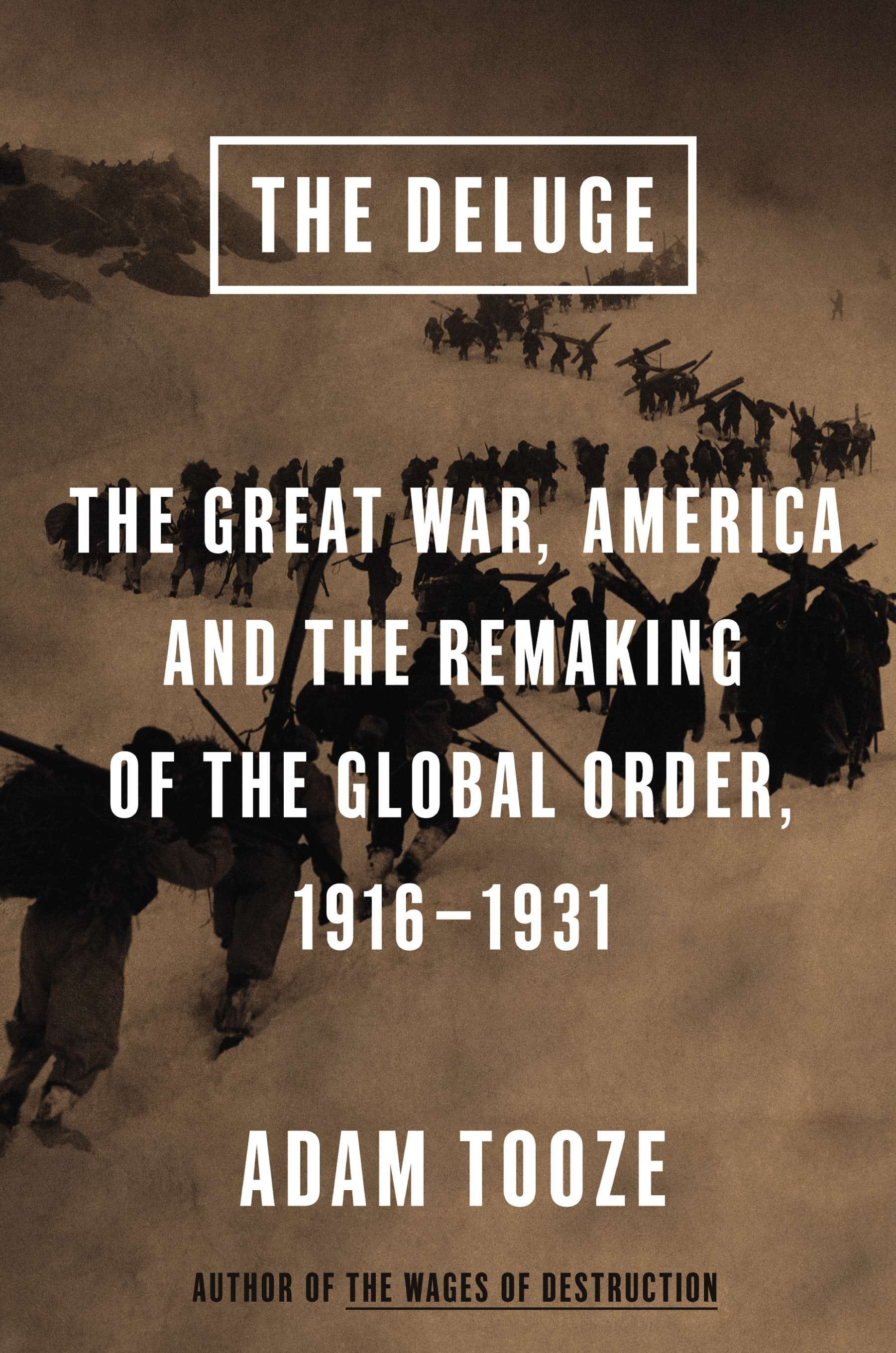
Ten years after World War I ended, what kind of international order had been established? With hindsight it must seem as though the postwar settlement was weak and lacked solid foundations. But this is not how it appeared at the time. In 1928, analysts as diverse as Winston Churchill, Leon Trotsky and Adolf Hitler, agreed that what had emerged from the Great War was a new international order framed by the power of the United States and the British Empire, and anchored on the European continent by the military predominance of the French Republic. This would be the order against which Hitler, Stalin, Mussolini and Imperial Japan would hurl themselves in the 1930s. As I described in Wages of Destruction, their challenge was of an unprecedented scale and this enormous effort was the backhanded compliment they paid to the order they were challenging. To understand what they were up against, we need to examine the preceding period in which the dominance of an American-centered world order first appeared. Deluge offers a new international history of the years after 1916, the moment at which the international order began to reorient itself around the pivot of American power.
The Real Story of How America Became an Economic Superpower
Adam Tooze’s study of the two world wars traces a new history of the 20th century.
Reviewed in the Atlantic by David Frum
RUSSIA - JAPAN WAR, 1904-05 (Video)
The Russo-Japanese War[a] (8 February 1904 – 5 September 1905) was fought between the Russian Empire and the Empire of Japan over rival imperial ambitions in Manchuria and the Korean Empire. The major land battles of the war were fought on the Liaodong Peninsula and near Mukden in Southern Manchuria, with naval battles taking place in the Yellow Sea and the Sea of Japan.
Economics ..
During his canvassing expedition in London, the Japanese vice-governor of the Bank of Japan Takahashi Korekiyo met Jacob Schiff, an American banker and head of Kuhn, Loeb & Co. Schiff, in response to Russia's anti-Jewish pogroms and sympathetic to Japan's cause, extended a critical series of loans to the Empire of Japan, in the amount of 200 million US dollars (£41.2 million). He also raised loans from the Rothschild family in Britain.[145][146] Japan's total war expenditure was 2,150 million yen, of which 38%, or 820 million yen, was raised overseas.[143]
No finance, no conflict.
It’s that simple.
Plus Bankers never acknowledge their responsibility in the act.
Their argument sidesteps the responsibility by saying that whoever barrows takes responsibility.
Strange really, because they often back both sides of a conflict, that’s like backing an horse both ways. They can’t lose, plus the finance is with fiat currency. Really they are sitting pretty either way.
Enter the loss of real assets provided by them and they won’t be participating that is the …Tell! Of their sincerity.
Plus, if they were held accountable for aiding the destruction of property and life, most conflicts would not last very long.