

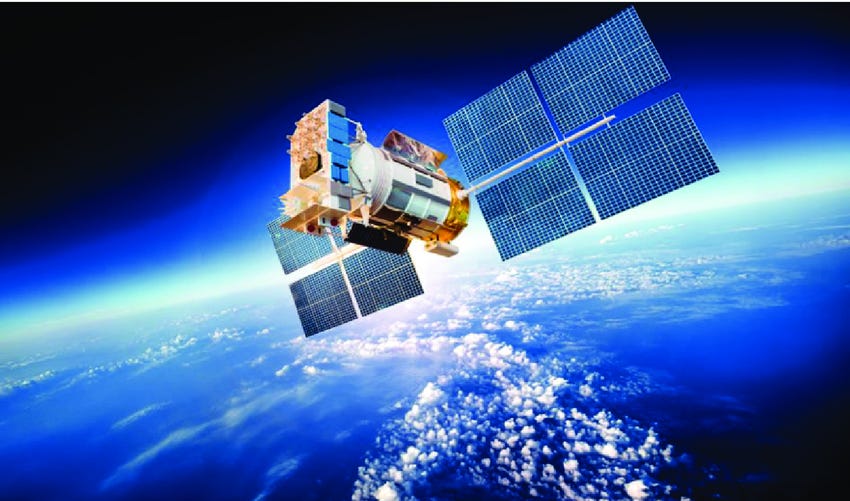
Are Iranian drones using Chinese GPS?
Yes. While “GPS” specifically refers to the U.S. Global Positioning System, Iranian drones and precision missiles rely heavily on China’s satellite navigation constellation—BeiDou—alongside Russian and Western satellite signals.
Key Navigation Technologies in Iranian Drones
Multi-Constellation GNSS Receivers: Modern Iranian drones, such as the Shahed series, rarely depend on a single satellite system. Instead, they use multi-system Global Navigation Satellite System (GNSS) chips capable of receiving signals simultaneously from U.S. GPS, Chinese BeiDou, Russian GLONASS, and European Galileo.
The National News
The Strategic Shift to BeiDou: Iran has systematically reduced its single-source reliance on U.S. GPS to counter Western signal-degradation and localized jamming. BeiDou offers dense satellite coverage and high accuracy across the Middle East, giving Iranian strike systems reliable positioning data.
Defence Security Asia+ 1
Anti-Jamming Integration (CRPA): By combining BeiDou and GLONASS reception with Controlled Reception Pattern Antenna (CRPA) technology, Iranian drones can filter out electronic warfare interference and directional “spoofing” (fake GPS signals), allowing them to maintain target trajectory in contested airspace.
The National News
Commercial and Dual-Use Supply Chains: Iranian defense manufacturers harvest dual-use navigation chips and circuit components manufactured in China, which are widely available on the open electronics market, allowing Tehran to assemble low-cost guidance packages despite international sanctions.
The National News
How does Chinese GPS compare with US Military GPS?
China’s BeiDou navigation system (specifically BeiDou-3, completed in 2020) and U.S. Military GPS (NAVSTAR GPS utilizing military M-code) represent the world’s two leading precision positioning, navigation, and timing (PNT) networks. While GPS established the technical standard, BeiDou was specifically designed to counter GPS vulnerabilities and modern electronic warfare.
Constellation Architecture & Orbit Strategy
U.S. Military GPS: Uses ~31 operational satellites positioned strictly in Medium Earth Orbit (MEO). It offers uniform global coverage, but typically yields fewer visible satellites overhead at any single point on Earth.
BeiDou-3: Uses a hybrid architecture of 45+ operational satellites across three orbital planes: MEO, Geostationary (GEO), and Inclined Geosynchronous (IGSO). This provides global coverage with a much higher density of visible satellites over Eurasia, the Middle East, and the Asia-Pacific.
Anti-Jamming & Signal Security
U.S. Military GPS: Relies on M-code (Military code), which features encrypted, high-power “spot beams” designed to burn through localized electronic warfare jamming, paired with SAASM/M-code chips to prevent signal spoofing.
BeiDou-3: Broadcasts military and civilian signals across three frequencies simultaneously (B1, B2, and B3). This multi-frequency structure gives it built-in signal redundancy against selective frequency jamming.
Targeting & Accuracy
U.S. Military GPS: Delivers sub-meter to centimeter-level positioning accuracy for military units equipped with Precise Positioning Service (PPS) receivers.
BeiDou-3: Achieves military accuracy on par with or exceeding GPS (centimeter-level). In the Asia-Pacific region, its GEO/IGSO satellites provide superior satellite geometry, reducing positioning errors compared to standard MEO-only constellations.
Two-Way Communication (Short Messaging)
U.S. Military GPS: Strictly a passive (one-way) broadcast network. GPS satellites send timing data down, but receivers cannot transmit data back to the constellation.
BeiDou-3: Features a native Short Message Communication capability via its GEO satellites. Authorized military receivers can send short data bursts (location reports, field commands, emergency messages) back through the satellite network without needing ground cellular or radio relays.
System Independence & Autonomy
U.S. Military GPS: Relies on a global network of ground tracking stations to maintain precise orbit and clock corrections.
BeiDou-3: Integrates inter-satellite optical (laser) links, allowing the satellites to sync clocks and calculate orbital metrics directly between themselves. This allows the constellation to remain operational even if domestic ground control stations are damaged or disconnected.
What is the "second mover advantage"?
The second-mover advantage (often referred to as the “fast-follower advantage”) is a business strategy concept where a company gains a competitive edge by entering a market after a pioneering first mover [1.1.1, 1.1.3]. Rather than taking on the massive risks and costs associated with creating a brand new market, the second mover observes what works, learns from the pioneer’s mistakes, and introduces an improved product or strategy [1.1.1, 1.1.3].
Key Benefits of Being a Second Mover
Learning from Mistakes: Second movers can analyze the first mover’s early missteps in product design, pricing, or target demographics and avoid them entirely [1.1.1, 1.1.3].
Reduced Costs: The first mover spends heavy capital on research, development, and educating consumers about a completely new concept [1.1.1, 1.1.3]. The second mover saves on these upfront expenses, capitalizing on a customer base that is already educated about the problem being solved [1.1.1, 1.2.5].
Validated Demand: Being a pioneer is incredibly risky because actual market demand is uncertain [1.1.3, 1.2.5]. A second mover enters with the confidence of validated demand—they know consumers are already willing to pay for the solution [1.1.1, 1.2.5].
Incremental Improvements: Unburdened by the pressure of creating something from scratch, second movers can focus their resources purely on executing a better, faster, or more specialized version of the product [1.1.3, 1.2.5].
Classic Real-World Examples
Google: Google was not the first search engine (following AltaVista, Lycos, and Yahoo) [1.2.5]. Similarly, Gmail launched in 2004, years after Hotmail and Yahoo Mail [1.1.1]. Google won by studying existing user frustrations and offering vastly superior technology, such as 1GB of email storage (100x the competitors) and much better search algorithms [1.1.1, 1.2.5].
Facebook: Entering the social media landscape after Friendster and MySpace, Facebook learned from the clutter, user-experience flaws, and scaling issues of its predecessors to build a cleaner, ultimately dominant platform [1.2.5].
The Disadvantages While highly effective, the second-mover approach is not a guaranteed success [1.2.5]. Second movers must play catch-up to overcome the first mover’s established brand recognition and market share [1.1.3]. If the first mover has locked in early customers through high switching costs, secured crucial patents, or built fierce brand loyalty, a second mover may struggle to capture the market and might simply be viewed as a copycat [1.1.3, 1.2.5].
Ultimately, winning as a second mover requires pristine timing and a clear value proposition that meaningfully differentiates the new offering from the original [1.1.1, 1.1.3].
QUESTIONS:
How many companies are expected to use Chinese GPS, rather than American GPS?
What effect will Chinese GPS have in adversaries’ ability to counter the US?
Does the “second mover advantage” alter incentives for being “first”?