

Are you aware how many government and semi-government institutions have plans for Digital ID and Digital money? See the list further down the page:
Transcript
0:00
There are three pillars that you’re watching. [music]
The first the middle pillar is the digital ID. But then there are two other pillars. On one side you have coercion
and then on the other side you have programmable money. [music] If we move there
then if [music] I want you to not be able to leave your home. Your money
won’t work if [music] you leave your home. If I want you to be able to eat foods made with insects and not be able to buy real meat, your money won’t work to buy real meat.
If I want you to take a vaccine a month and I mandate vaccines for you and your family, if you don’t, I’ll turn off your
money. [music] So I have complete control of your food, your healthcare,
your spatial travel, everything. So you are no longer in [music] a democracy or a democratic republic. You are in a
slavery system. If I want your kids to leave their home and go to a boarding school where I control their education,
[music] if you don’t agree, I turn off your money. Each person who backs out of the control grid and becomes more free makes it easier for the rest of us.
ELSEWHERE:
Are you aware that many governments and quasi-government institutions have plans for Digital ID and Digital Money?
Central Bank Digital Currency
Investopedia (Guide to CDBCs)
Wikipedia: CDBC
World Map Tracker: Deployment progress
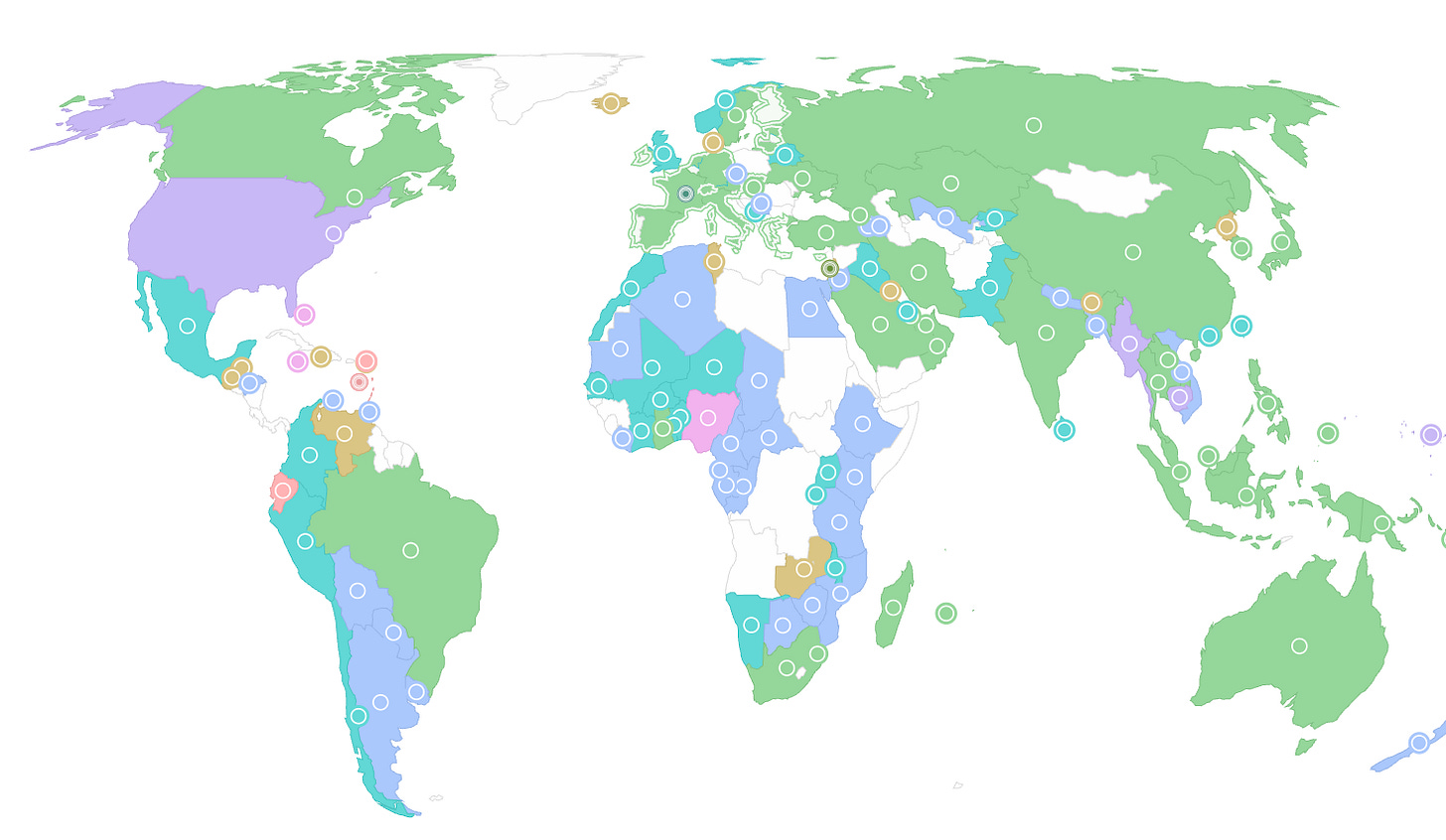
Click on map to see status of CDBC deployment...

Programmable Money
Federal Reserve: What is programmable money?
New York Federal Reserve: Programming Money Without Programmable Money
Citigroup: How Programmable Money Will Redefine Compliance and Control: Banks are uniquely positioned to offer what we call trusted programmability: digital money that carries embedded logic and the assurance of regulated deposits. They can integrate programmable capabilities into existing systems while maintaining capital, liquidity, and reporting standards.
Our analysis suggests that by 2030, transaction volumes for bank tokens could reach $100–$140 trillion, potentially surpassing stablecoins. That shift reflects enterprise demand for regulated compliant digital money—automation delivered with assurance.
American Banker : The promise and peril of programmable payments
This may sound stimulative and efficient — but programmable money introduces deeper, less technical risks than do on-chain programmable payments.
The most obvious is the blurring of our understanding of money. Transaction tokens with embedded functionality are not fungible with simpler tokens, breaking the “singleness” requirement that money be the same everywhere. For instance, can a token minted specifically for the purchase of bicycles be considered money?
A more sinister risk is that of behavioral control, with governments using programmable currency to influence or punish. For instance, China has experimented with distributing digital yuan to certain communities with the requirement that it be spent by a certain date, or expire. That sounds relatively harmless, but given the PRC’s emphasis on social stability and data gathering, we could also see digital currency use denied for those who attend protests, to pick an example. Russia has said that its central bank digital currency will allow programmability, to prevent its use by certain individuals or entities. As more jurisdictions launch digital currencies, it’s not hard to imagine the programmability of money being used in the future to stop the purchase of alcohol on Sundays, donations to certain causes or subscriptions to dissenting media.
But if programmable digital cash ends up replacing traditional money, the temptation to influence a population will be difficult to resist, no matter how much the authorities insist they respect the right to privacy.
Tech Fund: When Money Learns to Think: The Rise of Programmable Finance
At its core, programmable money is digital value whose transfer and behaviour are governed by code. It is built on a stack of technologies: distributed ledgers that maintain a shared state, smart contracts that execute deterministic logic, tokenization that represents value digitally, and oracles that connect real-world data to on-chain systems. Together, these components create a financial environment where execution replaces enforcement,1 and where outcomes are defined not by processes, but by code.
This transforms money from a passive medium of exchange into an active instrument of coordination. Logic no longer surrounds the transaction; it lives inside it.
Consider a gig marketplace where payment itself is programmable: funds are deposited upfront into a smart contract and remain locked until predefined conditions are met. The moment a task is verified as complete, payment releases instantly to the worker, with a percentage simultaneously routed to taxes or fees in the same transaction. If milestones aren’t met, funds revert automatically to the payer. No payroll cycles. No intermediaries holding custody. The money enforces its own rules, executing exactly as written, at any hour, without human oversight. Wages settle the instant work is proven. Incentives trigger the moment targets are reached.
Tokenized Real-World Assets (RWAs): Ownership Without Gatekeepers Programmability extends beyond currency into ownership itself. Through tokenization, real-world assets such as real estate, bonds, or commodities can be represented as digital tokens on a blockchain. These tokens can encode rights, obligations, and cash flows directly into their structure.
A commercial property worth $10 million can be split into 10 million tokens, each representing a $1 stake. Rental income flows automatically via smart contract. Tokens trade on secondary markets. The minimum ticket to real estate investing, historically reserved for institutions, drops to near zero.
This not just introduces fractional ownership, but also programmable ownership. Assets become dynamic systems capable of managing their own distribution, compliance, and lifecycle events.
The Agent Economy: When AI Becomes a Financial Participant
One of the quieter but most consequential shifts underway is the emergence of AI agents, autonomous software systems capable of planning and executing multi-step tasks without a human directing every move. These agents can already browse, analyze, and act. What they can’t do, under traditional financial infrastructure, is pay for anything without a human approving each transaction.
Programmable money removes that limitation. An agent can discover a service, evaluate its cost, execute a task, and settle payment, all within a single automated flow. This creates a machine-to-machine financial layer where transactions occur continuously, globally, and without human latency.
What emerges is an agent economy, an autonomous, composable layer where services are consumed and settled programmatically. In such a system, financial activity is no longer exclusively human-driven; it becomes an embedded function of software itself.
A smart digital currency could be programmed to expire after a set period, blocked in certain spending categories, or denied to individuals who violate policy. This capacity to influence behaviour transforms money from a neutral medium into an active regulatory tool. This raises the concern that freedom is no longer about what you can do with money, but what the system allows you to do.
This appeals as a suitable medium of currency for states that proactively want to restrict their people’s behaviour: programmable money that the state controls is programmable money the state can restrict. A CBDC with full government programmability could possibly function less as a liberation of finance and more as an extension of state influence into a medium that has historically offered some degree of privacy and autonomy.
QUESTIONS:
Were you aware that Central Bank Digital Currencies and Programmable money had so much mindshare with regulators, banks, and corporations?
Were you aware how different digital money can be from our current type of money in functioning as a method of executing and coordinating plans, not just a medium of exchange?
Did you know that there are powerful interests who would like to “digitize” stocks, bonds, real estate, and natural resources into fractional ownership “tokens”?
If these changes to money take place, how do you anticipate it could affect you?
What do the “bad case” scenarios look like?
FOOTNOTES:
“execution replaces enforcement”: Instead of traditional regulation by the actions of government employees, regulation is performed by the execution of computer code, which controls what permission you have to your money or other electronic connected systems (like a gate). For example, if you attend a protest the government doesn’t like, instead of a police officer (enforcing) pre-existing rules against rioting, AI could (execute computer code) to turn off your money, or perhaps limit your money to working within 5 miles of your home, for example.