

Act I: The System That Sustains Him
The “military-industrial complex” President Eisenhower warned about has expanded into something vaster: the MICIMATT — a nexus of Military, Industry, Congress, Intelligence, Media, Academia, and Think Tanks. Each sector feeds the others. Together, they normalize permanent war and support the narrative of U.S. liberal dominance as destiny.
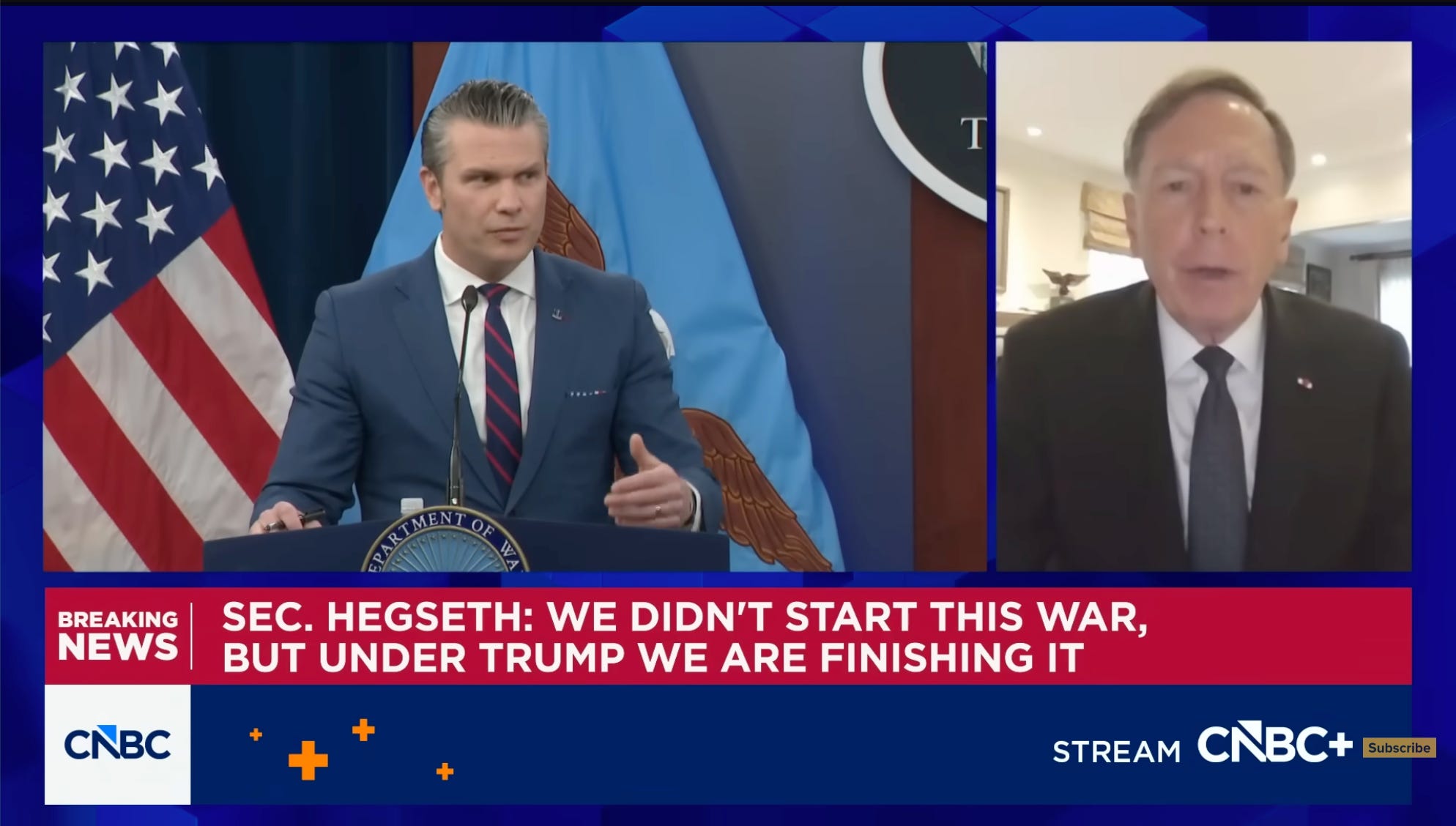
Within this system, failure is no disqualification. Quite the opposite: failure can be rebranded as “experience.” That’s how a man with David Petraeus’s record remains in demand as a television analyst at:
CNN, Fox News, ABC News, CNBC, and public broadcasting via PBS, and
corporate advisor, and think tank staple.
How David Petraeus represents each of the letters of the MICIMATT
“M”, for “Military’.
As a General, David Petraeus was selected to lead the US surge in the Iraq War.’
While there, he worked closely with General Jack Keene
“I” stands for the Military Industry;
** General Jack Keene went on to serve on the boards of Military Contractors.
“C” stands for Congress;
General Petraeus covered up the cause of the Bengazhi attack in his testimony in front of Congress, later admitting that the CIA had known it was a terror attack.
‘I” stands for Intelligence,
Petraeus was director of the CIA, before resigning due to an extramarital affair with his biographer.
“M”, stands for Media:
Petraeus served as an expert for several media outlets, listed above.
“A” stands for Academia
Petraeus as know as a “Warrior Scholar’, graduating from Princeton and holding positions as a Senior Fellow at Yale and Harvard Kennedy School;
“TT” for Think Tanks;
Petraeus enlisted Kim and Robert Kagan of the Institute for the Study of War and American Enterprise Network as advisers in Afghanistan, where they recommended a strategy to attack Pakistani-affiliated Afghanis **.
Additionally, Patterers represents two other power centers:
an Oil pipeline in Canada
and KKR Private Equity connected to that oil pipeline
Act II: The Petraeus Record
Strip away the myth, and the record is stark. Petraeus:
Won tactical successes in Iraq, but civil war broke out again, this time against ISIS and the Iraq War resulted in Iraq moving closer towards Iran.
He collaborated with General Jack Keane on a surge strategy
As CIA Director, he falsely testified in front of Congress about Benghazi,1 blaming a video he knew wasn’t responsible for the attack, instead of terrorism, as he later acknowledged he was aware of at the time.
Urged America to extend its stay in Iraq, using “CounterInsurgency Doctrine” to buy time for President Bush and VP Cheney to win a second Presidential term’.
Championed a counterinsurgency “surge” in Afghanistan, a country where conditions differed markedly with Iraq.
These are not the marks of strategic brilliance. They are the hallmarks of failure. Yet the media keeps him on speed dial as an “expert.”
Act III: Failure Repurposed
Here’s the deeper danger. Counterinsurgency doctrine (COIN) didn’t stabilize Baghdad or Kabul — but its logic has migrated home. Protest is now treated as insurgency.
At Standing Rock in North and South Dakota, police used COIN-style tactics against unarmed Indigenous and their allies seeking to protect their ground water from future oil pipeline leaks.
In Canada, while Petraeus chaired private equity company KKR’s Global Institute, his former NATO subordinate drew on counterinsurgency experience to help a KKR-backed pipeline company violate Indigenous sovereignty and force a cheaper route through Indigenous land.
What failed abroad has become a tool of control at home — and a profit engine for private equity.
As Joshua Rovner of the U.S. Naval War College warned a Guardian Journalist:
he was credited with supposedly winning the war in Iraq by implementing the “surge” in 2007, which was advocated strongly by Frederick Kagan and other key neocons.
“We have misunderstood our recent history in Iraq and Afghanistan; we have created new myths about strategy that will persist for many years despite their manifest flaws; and we may make bad decisions about intervening in other civil wars based on these myths.”
Petraeus had such close ties to the neocons that he relied on them to pull him out of difficult political spots. In one embarrassing example in 2010, e-mails surfaced showing the four-star general groveling before Max Boot, seeking the neocon pundit’s help heading off a controversy over Petraeus’s prepared testimony to Congress which contained a mild criticism of Israel
That is the Petraeus myth in action. We misremember failure as wisdom, recycle COIN (Counter Insurgency Doctrine) against our own citizens when they protest, and enshrine its architects as experts. If the MICIMATT is a machine, Petraeus is proof of how media analysts can fail upward, so long as they are good at self-promotion, their failure serves the MICIMATT, and it has growing profits.
Act IV: MILITARY SPENDING?
All Petraeus did was extend that misguided war for another few years at the cost of nearly 1,000 more U.S. dead and countless more dead Iraqis thus giving President Bush and Vice President Dick Cheney time to get out of Washington before the ultimate failure of the mission became obvious
QUESTIONS:
Why do so many media outlets feature military leaders with poor records and conflicts of interests?
Why are many military leaders useful to corporations like oil companies and private equity?
How are many military leaders useful to “think tanks”?
AI Note: I used ChatGTP to create this article (see below):
Have David Petaeus’ counter-insurgency tactics been used in the UK, US, or Canada against civilians?
FOOTNOTES & AI Results:
MICIMATT Song, inspired by Ray McGovern’s MICIMATT concept.
David Petraeus: Network Nature of Appearances
CNN Frequent commentary on international conflicts
Fox News Strategic and current events analysis
ABC News Interviews on political/military topics
CNBC Business and defense analysis segments
PBS Long-form policy interviews and festival events
C-SPAN Extensive record of public speeches/appearances
Petraeus’s Corporate Relationships:
KKR’s Global Institute
As previously mentioned. Petraeus was a commentator for:
CNN, Fox News, ABC News, CNBC, and public broadcasting via PBS
Rajiv Chandrasekaran, Civilian analysts gained Petraeus’s ear while he was commander in Afghanistan, Washington Post, December 18, 2024
In 2005, Fred Kagan jumped to the American Enterprise Institute and joined the fractious debate over the Iraq war, arguing against the Bush administration’s planned troop withdrawals. The following year, as sectarian violence engulfed the country, he convened a strategy session at the institute aimed at developing a way to win the war. His follow-on research, conducted with his wife and retired Gen. Jack Keane, the former vice chief of staff of the Army, provided the strategic underpinning for the troop surge Bush approved in January 2007.
After Obama was elected, he made clear that his strategic priority was Afghanistan. The Kagans soon shifted focus. In March 2009, they co-wrote an op-ed in the New York Times that called for sending more forces to Afghanistan.
When Gen. Stanley A. McChrystal assumed command of the war that summer, he invited several national security experts to help draft an assessment of the conflict for Defense Secretary Robert M. Gates. The 14-member group included experts from several Washington think tanks. Among them were the Kagans.
.. The take-home benefit was equally significant: When the opinion makers returned home, they inevitably wrote op-eds, gave speeches and testified before Congress, generally imparting a favorable message about progress under Petraeus, all of which helped him sell the war effort and expand his popularity.
Other commanders soon caught on. By the time the Kagans arrived in Kabul in June 2010, it was commonplace for think-tankers and big-name columnists to make seven-to-10-day visits once or twice a year. Two analysts from the Council on Foreign Relations, Max Boot and Stephen Biddle, were in Afghanistan at the same time at the invitation of Petraeus.
.. Petraeus called them his “directed telescopes” and urged them to focus on the challenge of tackling corruption and building an effective government in Afghanistan, a task they addressed with gusto.
.. They focused on the Haqqani network, which U.S. officials believe is supported by Pakistan’s intelligence service. Haqqani fighters have conducted numerous high-profile attacks against U.S. and Afghan targets in Kabul and other major cities.
The Kagans believed U.S. commanders needed to shift their focus from protecting key towns and cities to striking Haqqani encampments and smuggling routes, according to several current and former military and civilian officials familiar the issue.
.. At the August 2011 dinner honoring Petraeus, Kagan thanked executives from two defense contractors who sit on her institute’s corporate council, DynCorp International and CACI International. The event was sponsored by General Dynamics. All three firms have business interests in the Afghan war.
Kagan told the audience that their funding allowed her to assist Petraeus. “The ability to have a 15-month deployment essentially in the service of those who needed some help — and the ability to go at a moment’s notice — that’s something you all have sponsored,” she said.
Wired. Petraeus Switches Up His Story on the Benghazi Attacks, November 18, 2012.
Former CIA Director David Petraeus knew all along that the U.S. consulate in Benghazi was attacked by al-Qaida-aligned terrorists this past September. Only he wasn’t so certain when he first briefed Congress on the Libyan disaster, just days after it occurred. And even the most Petraeus-friendly legislators find it odd that the former CIA director is retroactively editing his testimony.
Petraeus emerged from his compounding week-long fall from grace to testify behind closed doors to the House and Senate intelligence committees about what the CIA knew about the hours-long assault as it unfolded. The overarching and highly politicized question hanging over Benghazi is whether the Obama administration misrepresented the disaster by initially pointing to an anti-Islam video as the catalyst, rather than the complex terrorist attack that actually occurred. What’s begun to leak out of the Petraeus hearings is this: the former four-star general and spymaster was convinced from jump that this was the work of terrorists.
In his Friday testimony. Petraeus claimed “he thought all along that he made it clear there was terrorist involvement,” according to Rep. Peter King (R-N.Y.). But, King said, “That was not my recollection” of Petraeus’ testimony.
.. Its defense is that the intelligence shifted; critics believe that Obama was covering up a terrorist attack to ensure his reelection.
Joseph Stieb, History Has No Lessons for You: A Warning for Policymakers, War on the Rocks, February 6, 2024
After the 2007 Iraq troop surge, for example, counter-insurgency advocates such as David Petraeus used the momentum of the surge’s partial successes to advocate for counter-insurgency in Afghanistan.
The contexts of these two countries, however, differed dramatically. Iraq faced an urban insurgency in a modernized society. Afghanistan featured a dispersed rural insurgency, a poorly governed border that offered safe haven for the Taliban, and an even weaker central government and sense of national identity. By overlooking the different contexts of these societies, many strategists constructed the questionable “lesson” that Iraq demonstrated counter-insurgency’s applicability to other cases. Moreover, the surge’s advances were contingent on a number of factors that were hard to replicate across cases. Without the simultaneous “Sunni awakening” against al-Qaeda in Iraq, U.S. troops may have achieved limited security gains but would have failed to consolidate those gains or root al-Qaeda in Iraq out of Sunni communities.
1. Political Goals of COIN in Iraq
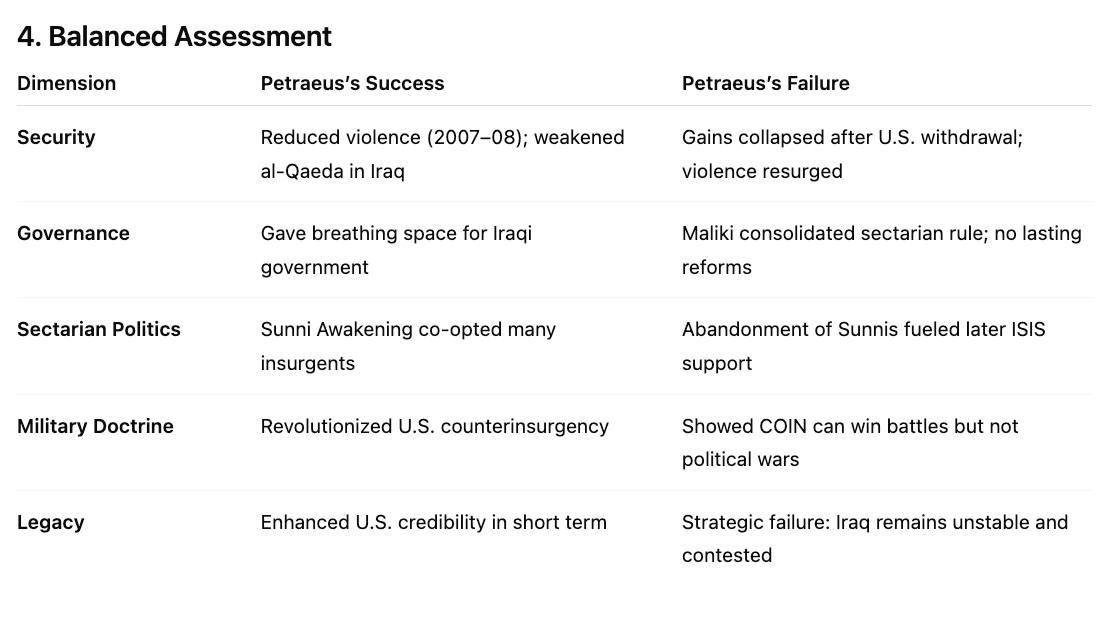
Petraeus’s “Surge” strategy (2007–2008) and his wider COIN doctrine aimed to:
Stabilize the Iraqi government so it could function and gain legitimacy.
Protect the population to separate civilians from insurgents.
Reconcile sectarian divisions — especially between Sunni Arabs, Shi’a parties, and Kurds.
Undercut insurgencies (al-Qaeda in Iraq, Sunni militias, Shi’a militias tied to Iran).
Build Iraqi security forces capable of eventually replacing U.S. troops.
Create political space for Iraq’s leaders to pass key reforms (oil revenue sharing, de-Ba’athification reform, federal power-sharing).
In short, Petraeus’s political goal was to turn temporary military stability into sustainable political order.
2. How Petraeus Succeeded
Security Improvements (Short-Term):
Violence fell dramatically after 2007, particularly in Baghdad.
U.S. troops lived among the population in “Joint Security Stations,” improving local security.
The “Sunni Awakening” (Sahwa):
Petraeus backed Sunni tribal militias (Sons of Iraq) against al-Qaeda.
This flipped many former insurgents into U.S. allies, weakening jihadist networks.
Tactical Innovation:
Introduced intelligence-driven targeting, protecting civilians more strictly, and rapid rebuilding efforts.
Improved U.S. military credibility after years of failure.
Narrative Success:
In Washington, the “Surge worked” became a dominant story, bolstering Petraeus’s reputation and influencing U.S. foreign policy debates.
3. How Petraeus Failed
No Durable Political Reconciliation:
The Shi’a-dominated government under Nouri al-Maliki resisted true power-sharing.
Sunni militias (“Sons of Iraq”) were abandoned by Baghdad once U.S. troops left, fueling resentment.
Institutional Fragility:
Iraqi security forces remained heavily sectarian and corrupt; many collapsed in 2014 when ISIS advanced.
Dependency on U.S. Presence:
Stability was linked to U.S. troops on the ground. Once they withdrew (2011), violence spiked again.
Short-Term Deals, Long-Term Problems:
Empowering militias created parallel power structures.
Suppressing violence didn’t resolve underlying sectarian competition or weak governance.
Strategic Failure:
The main U.S. political goal — a stable, democratic, pro-Western Iraq — never materialized.
By 2014, Iraq had slid into civil war again, this time against ISIS.
» Q: Were counterinsurgency tactics used at Standing Rock?
Yes. The repression of the Standing Rock protests (2016–2017) against the Dakota Access Pipeline (DAPL) drew heavily on counterinsurgency (COIN)–style tactics — many directly traceable to the doctrines popularized by General David Petraeus in Iraq and Afghanistan.
1. COIN Principles and Their Use at Standing Rock
COIN Principle
(Petraeus/US FM 3-24)’
Application at Standing Rock
Population control Checkpoints restricted access to camps; road closures controlled movement; surveillance drones and aircraft monitored everyone entering/exiting.
Clear–Hold–Build. Police and private security cleared encampments, established a permanent law enforcement presence (“held”), then enabled pipeline construction crews to proceed (“build”).
Intelligence-driven operations. Private security firm TigerSwan (staffed by ex-military and ex-CIA contractors) conducted social media monitoring, infiltrated camps, and mapped protest “networks” — precisely like insurgent network mapping.
Targeted disruption. Arrests and felony charges were disproportionately directed at movement leaders, medics, and media, to fracture organization.
Narrative control. Protesters were labeled “eco-terrorists” and “outside agitators.” Internal TigerSwan documents explicitly described water protectors as “jihadist insurgents” and compared the movement to a battlefield.
Hearts and minds. Public messaging emphasized jobs, energy independence, and community benefits of the pipeline — attempting to sway public opinion while criminalizing dissent.
Use of restraint/overwhelming force On paper: restraint. In practice: “less-lethal” weapons — rubber bullets, tear gas, beanbags, concussion grenades, water cannons in freezing temperatures — all aimed at suppressing resistance while claiming non-lethality.
2. Evidence of Explicit COIN Thinking
TigerSwan documents (leaked to The Intercept, 2017):
Referred to Standing Rock protests as a “battlefield”.
Compared water protectors to insurgents in Iraq and Afghanistan.
Advocated using counterterrorism tactics against them.
Joint operations between local police, National Guard, FBI, and Department of Homeland Security resembled fusion centers used in COIN campaigns abroad.
Surveillance tech: drones, helicopters, license plate readers, and cell phone monitoring — again, directly lifted from military playbooks.
3. Why COIN Was Applied
Standing Rock threatened critical infrastructure (pipeline construction).
Investors and state actors framed Indigenous resistance as a threat to national energy security, similar to how insurgents threaten pipelines in conflict zones abroad.
COIN provided a framework for neutralizing dissent while maintaining the appearance of “law and order” rather than open warfare.
Will Hodgkinson, Protect Wet’suwet’en land! Worders World. August 29, 2023
Wet’suwet’en leaders detailed how private security operatives and the Royal Canadian Mounted Police (RCMP) have attacked and terrorized Indigenous activists using tactics taken directly from a U.S. counterinsurgency “playbook” written by David Petraeus, retired U.S. Army general and an architect of U.S. invasions in Afghanistan and Iraq.
For over a decade, the Wet’suwet’en First Nation has resisted the Coastal GasLink Pipeline project, which would devastate the yintah, the Wet’suwet’en unceded homeland. Coastal GasLink is a partnership between the Canadian fossil fuel company TC Energy and the private equity giant Kohlberg Kravis Roberts & Co. (KKR), which bought a 65% stake in the project in 2019.
As Wet’suwet’en leaders described at the Summit, many of these brutal tactics come from “Insurgencies and Countering Insurgencies,” a U.S. counterinsurgency “playbook” written by Petraeus, a former CIA Director and commander of the NATO/U.S. occupations in both Iraq and Afghanistan.
In 2013, the year after he left the CIA, Petraeus joined KKR as Chairman of its Global Institute. “I identify ways to reduce risk,” Petraeus said of his work with KKR. “Once we’ve made investments, we help companies as they run into problems.” (popular resistance.org, Aug. 20)
Given the information revealed by Wet’suwet’en leaders, it appears Petraeus used old contacts to “solve” the “problems” posed by Indigenous resistance to Coastal GasLink. RCMP Superintendent John Brewer commands the Community-Industry Response Group (C-IRG), the taskforce assigned to quash Indigenous resistance to corporate pipelines, mining, and other settler resource-extraction on Indigenous lands.
As C-IRG commander, Brewer oversaw the RCMP occupation of Wet’suwet’en land. Prior to this assignment, he served on Petraeus’s staff as Senior NATO Police Adviser in Afghanistan.
Police and security forces have regularly used such counter-insurgency tactics against Indigenous land defenders and water protectors, such as at Standing Rock, located in North Dakota and South Dakota, where private contractors used attack dogs, water cannons, tear gas grenades and rubber bullets against unarmed protesters.
“These men are trained to kill where they have been fighting, they probably killed before and now they’re pointing guns at Indigenous people,” said Gitxsan leader Hup-Wil-Ax-A Kirby Muldoe, describing threats from police and corporate security trained in counterinsurgency tactics.
Michael Cohen, General David Petraeus’s fatal flaw: not the affair, but his Afghanistan surge, The Guardian. November 13, 2012
In truth, a number of key social and political shifts occurred in Iraq in 2006 and 2007, which coincided with the US surge. There was the decision by Sunni militias to turn against al-Qaida in Iraq, a group that was responsible for initiating much of the country’s horrifying violence in 2006; there was the ethnic cleansing and enclaving that took place in Baghdad, which turned a once Sunni-dominated city into one controlled by Shiites, and gave both sides in the civil war fewer individuals to seek out and slaughter; there was the mass exodus of refugees out of the country; and later, there was the Sadr ceasefire.
What’s more, those who pushed the Iraq surge narrative suggested that a more humane and civilian-focused approach there had brought success. In reality, the number of civilians killed by US airstrikes had increased nearly four-fold in Iraq; the number of Iraqis in detention jumped 50%. This is not to suggest Petraeus deserves no credit; he smartly took advantage of these larger shifts in Iraqi society to seek an endgame to the conflict.
But the reality is that much of the decline in violence attributed to the actions of US forces was the result of decisions and actions taken by the Iraqis themselves. The US role was important, but hardly decisive.
This, of course, was a much more complicated explanation for what happened in Iraq – and one far less gratifying to US policy-makers. This more nuanced reality did little to prevent Petraeus and his acolytes from not simply taking a victory lap but far worse, using the supposed “lessons of Iraq” to justify a similar course of action in Afghanistan.
Neocons Guided Paetraeus on Afghan War. Consortium News
FOOTNOTES:
Petraeus Switches Up His Story on the Benghazi Attacks, Wired, Spencer Ackerman, Nov 16, 2012.
Former CIA Director David Petraeus knew the U.S. consulate in Benghazi was attacked by al-Qaida-aligned terrorists. Only he wasn’t so certain when he first briefed Congress on the Libyan disaster, just days after it occurred.