

You’ve probably heard of individuals involved in road rage or certain crimes sentenced to take “anger management” classes. This aroused my curiosity — do these classes actually work, and how?
How do “Anger Management” Classes Work? Gemini
Anger management classes help you understand, process, and regulate intense emotional reactions. Rather than suppressing anger, the goal is to identify root triggers and learn healthy, constructive ways to respond before anger escalates into destructive behavior.
Core Structure & Delivery
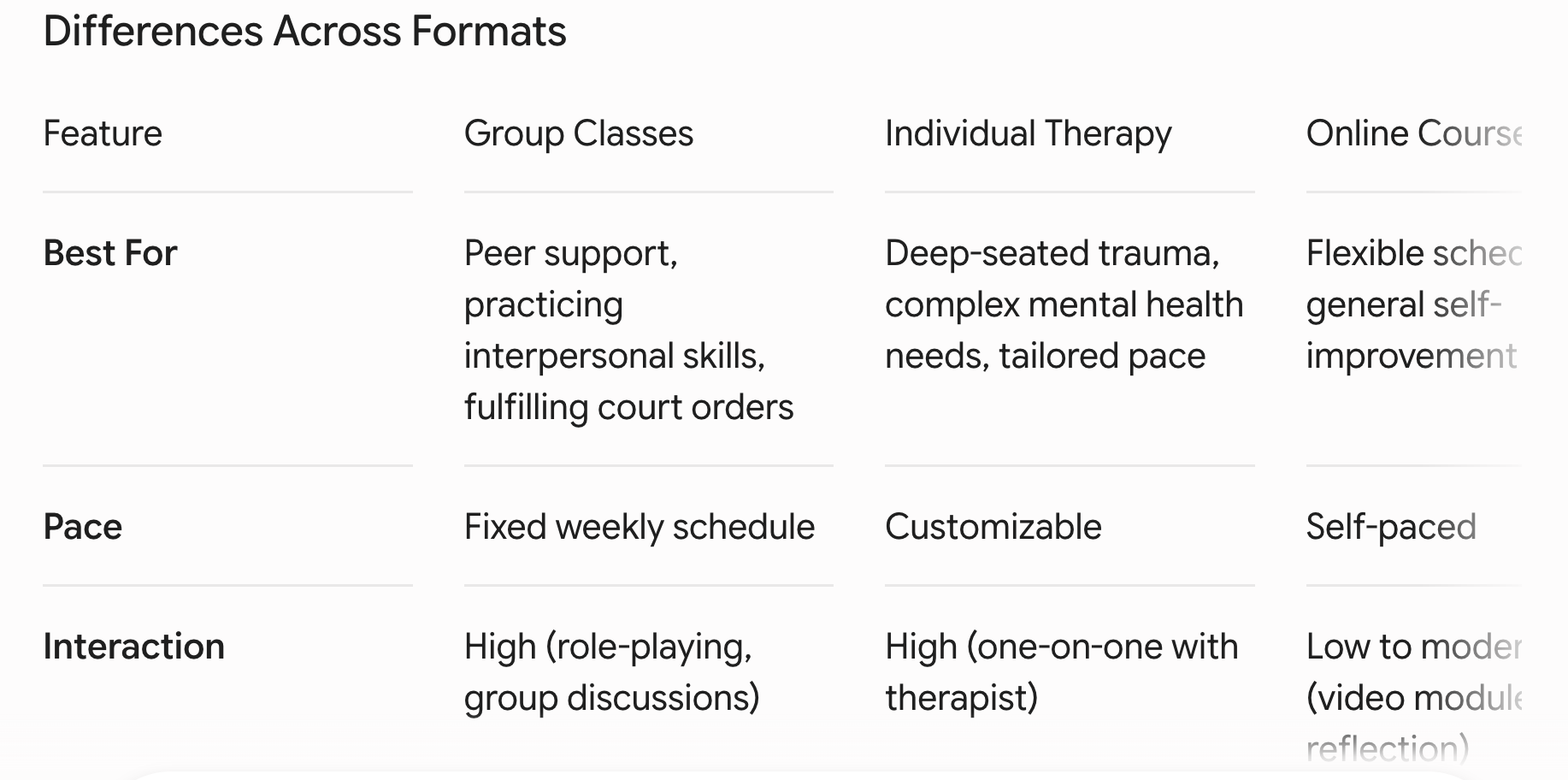
Format Options: Offered as individual counseling, structured group sessions, or certified online courses. Group settings are common because hearing others’ experiences helps normalize struggles and provides opportunities to role-play responses.
Duration: Typically ranges from 4 to 12 weeks, with weekly 60-to-90-minute sessions. Court-ordered or state-mandated classes often require a specific total number of hours (e.g., 8, 12, or 26 hours).
Curriculum Focus: Most programs rely on Cognitive Behavioral Therapy (CBT), which focuses on the relationship between thoughts, emotions, and actions.
What You Learn
Trigger Identification: Pinpointing specific situations, phrases, or internal stressors (like fatigue, stress, or feelings of injustice) that activate your anger.
Physical Awareness: Recognizing early body signals—such as elevated heart rate, muscle tension, or clenched jaw—that indicate anger is building before you react impulsively.
Cognitive Restructuring: Learning to notice “cognitive distortions” (like black-and-white thinking or catastrophic assumptions) and reframing them logically.
De-escalation Techniques: Practical tools like deep breathing, taking structured time-outs, and grounding exercises to lower physiological arousal.
Assertive Communication: Shifting from aggressive responses to clear, direct communication (such as using “I” statements) to address conflicts productively.
Assessment & Completion
Initial Assessment: Programs usually begin with an intake evaluation to understand your goals, history, and whether anger management or a different intervention (such as therapy for trauma or substance abuse) is most appropriate.
Certificates: Upon completing required attendance and participation milestones, programs issue a formal certificate of completion, which satisfies court, workplace, or legal mandates.
Anger management classes operate through a structured psychological framework designed to interrupt automatic, destructive reactions. Rather than forcing you to “stop feeling angry,” these classes treat anger as a secondary emotion—a signal pointing to underlying stress, hurt, or perceived threats—and teach you how to handle that signal constructively.
The Core Psychological Framework
Most classes rely heavily on Cognitive Behavioral Therapy (CBT) and Dialectical Behavior Therapy (DBT). These approaches break down an angry episode into four distinct stages:
[Trigger Stage] ➔ [Physiological Spike] ➔ [Automatic Thoughts] ➔ [Behavioral Response]
Trigger Stage: The external event or internal memory that starts the reaction.
Physiological Spike: Your sympathetic nervous system initiates a “fight-or-flight” response, pumping adrenaline and cortisol into your system.
Automatic Thoughts: Rapid, often distorted interpretations of the situation (e.g., “They’re disrespecting me on purpose” or “This is completely unfair”).
Behavioral Response: The outward action (yelling, stonewalling, physical aggression, or passive-aggressive behavior).
Classes target stages 2 and 3 so you can change stage 4.
Key Skills and Techniques Taught
1. De-escalating the Body (Physiological Control)
When your heart rate exceeds roughly 100 beats per minute, higher-level executive functioning in the brain (the prefrontal cortex) shuts down, making rational thought difficult. Techniques taught include:
Progressive Muscle Relaxation (PMR): Systematically tensing and releasing muscle groups to drop physical tension.
Controlled Diaphragmatic Breathing: Slow, deep breaths that stimulate the vagus nerve and activate the parasympathetic nervous system (the body’s “brake” pedal).
Strategic Time-Outs: A agreed-upon protocol for stepping away from a conflict for 20–30 minutes until your physiology normalizes.
2. Reframing the Mind (Cognitive Restructuring)
Anger is frequently fueled by unhelpful thought patterns. Classes help you identify and correct these:
“Should” Thinking: Believing people or circumstances must behave a certain way.
Mind Reading: Assuming you know someone else’s negative motives.
Personalization: Taking neutral or unrelated events as direct personal attacks.
You learn to challenge these thoughts with questions like: “Is there another explanation for this?” or “Will reacting strongly right now solve the issue?”
3. Constructive Expression (Communication & Boundaries)
Replacing aggression with assertiveness involves:
“I” Statements: Framing concerns around your experience rather than blaming the other person (e.g., “I feel overwhelmed when plans change without notice” instead of “You always ruin our plans”).
Problem-Solving Frameworks: Shifting focus from who is to blame to what concrete step can resolve the immediate issue.
What a Typical Session Looks Like
Check-in (10–15 mins): Participants share instances from the past week where they felt anger, evaluating how they handled it using class tools.
Skill Introduction (20–30 mins): The instructor introduces a specific concept or skill (e.g., boundary setting, conflict styles, or emotional triggers).
Practical Application & Role-Play (20–30 mins): Participants practice the skill in realistic scenarios with feedback from the group or instructor.
Assignment & Reflection (5–10 mins): Reviewing worksheets, anger logs, or practice goals for the upcoming week.
QUESTIONS:
How many anger management graduates reoffend?
If they work, should more people take anger management classes?
When is anger appropriate and how should it be expressed?