

SUMMARY:
Israeli citizens have different rights, depending on their “nationality,” which is based on their ethnicity. This affects where they may live.1
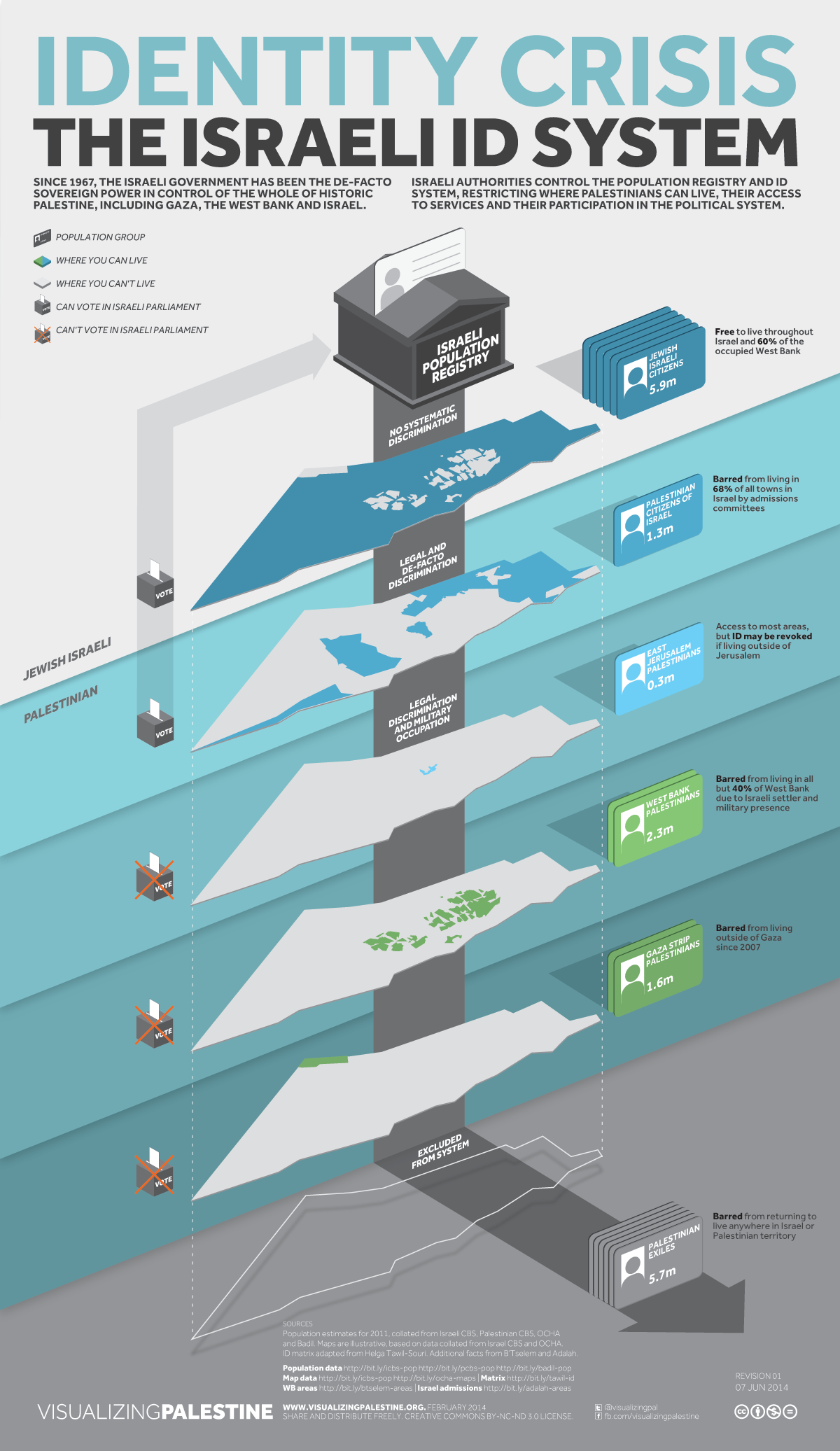
Source: https://visualizingpalestine.org/visual/identity-crisis-the-israeli-id-system/
The primary nationalities recognized in Israel’s internal registry include:
Jewish (the majority nationality)
Arab (including Muslim, Christian, and Druze subgroups)
Circassian
Armenian
Baha’i
Samaritan
Assyrian
Aramean
Maronite
Coptic
There are approximately 130 different “nationalities” recognized in total. While some sources note that Israeli ID cards may simply list "Israeli" for all citizens, the internal population registry maintains these distinct ethnic-religious classifications, a system the Israeli Supreme Court has upheld to preserve the state's Jewish character.
Source: Brave AI
RELATED:
2013 Supreme Court ruling on nationality (Wikipedia)
MYTH: All Israelis are equal
Whenever Israel is accused of being undemocratic or being an Apartheid state, one of the main counter-arguments used by its advocates is that everyone in Israel is politically equal. They’ll often cite examples of “Arab” judges or members of Knesset to reinforce their point. We have specifically discussed the issue of Apartheid more thoroughly in [This article], and while they are connected, the goal of this article is to inspect the narrower claim that every Israeli citizen is equal.
While such a claim is very attractive to defenders of Israel, how realistic is it?
At first glance it does seem that all citizens in Israel enjoy the same rights, they can all vote, for example, among many other rights granted by citizenship. However, after a more thorough look it becomes clear that this talking point is only held together by the omission of one very important fact:
Israel distinguishes between citizenship and nationality.
What does this mean?
For example, you can be a citizen of Israel but be a Druze national, or a Jewish national. Your nationality is determined by your ethnicity and it cannot be changed or challenged. But how is this relevant to the original question being discussed?
It is relevant because many of the rights you are accorded in Israel stem from your nationality not your citizenship. Meaning an “Arab” Israeli citizen and a Jewish Israeli citizen, while both citizens, enjoy different rights and privileges determined by their “nationality”. Seeing how Israel is an ethnocracy it is not a mystery who this system privileges and who it discriminates against [You can read more about this here].
This is not merely discrimination in practice, but discrimination by law. Adalah have composed a database of discriminatory laws in Israel that disfavor non-Jewish Israelis. For example, the Law of Return and Absentees’ Property Law are but two examples of flagrant racism and discrimination in the Israeli legal system [You can read more about this here].
Source: DecolonizePalestine
ELSEWHERE:
Israel expands law that allows villages and towns to ‘reject Palestinians’, Middle East Eye, Lubna Masarwa in Jerusalem and Elis Gjevori in Istanbul, July 27, 2023.
FOOTNOTES:
Note: There is local level of committees that filter residents based on "cultural fabric". Read more about it.