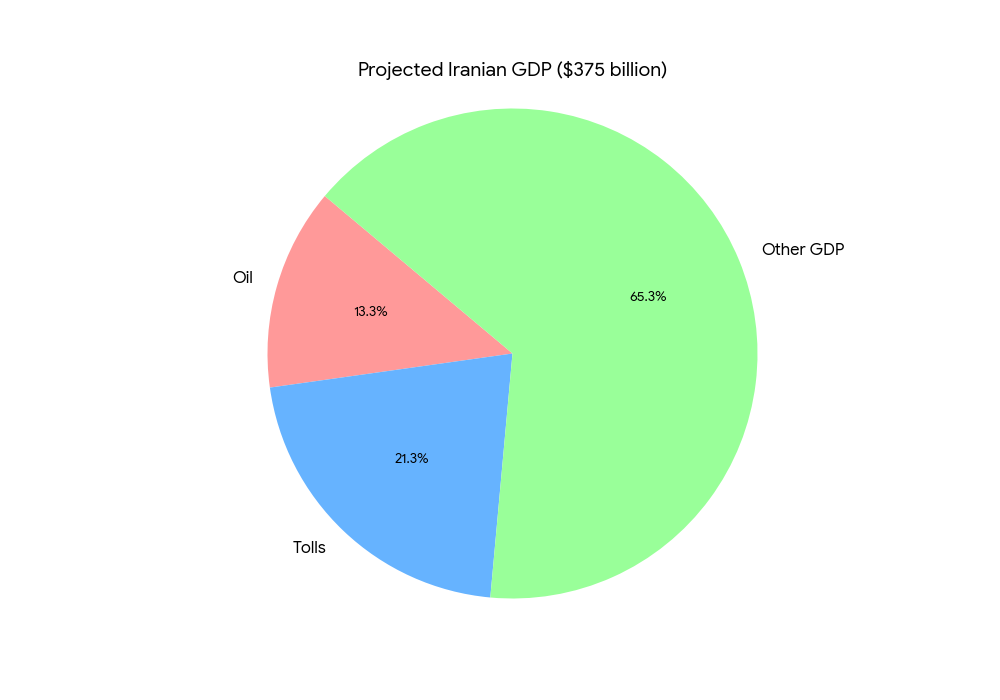
Did you know that revenue from Iran’s Tolls at the Strait of Hormuz is expected to be greater than its oil revenue?
This gives Iran a powerful incentive to maintain the toll.
Oil: $50 billion per yer = 13.3% GDP
Tolls: $80 billion per year = 21.3% GDP
GDP IMF 2026 Estimate: $375 billion
DETAILS:
Oil:
2022: $35-45 billion on volume of 0.6 - 1 million barrels per day.
2024: $35.76 billion
2026: $50.7 billion with oil prices exceeding $100per barrel
Tolls:
Iran eyes $80 billion windfall with Strait of Momuz toll plan (
As Iran explores potentially imposing a fee on vessels crossing the Strait of Hormuz, officials in Tehran estimate the move could generate significant revenue. According to Iran International, Yahya Al-e Es’hagh, head of the Iran-Iraq Joint Chamber of Commerce, suggested Tehran could theoretically generate between $70 billion and $80 billion annually by levying fees on ships using the strait, which carries a significant share of global commerce.
Estimates from Iranian economists suggest Tehran could earn as much as $60 billion annually from transit tariffs alone, while some officials have floated even higher projections of up to $70–$80 billion if a broader fee system is fully enforced across the waterway. (India Times)
PBS News Analysis
Some economists say that, from a strictly financial standpoint, the world would barely notice the additional costs from any tolling in the Strait of Hormuz.
For example, a $2 million toll on a large tanker carrying 2 million barrels of oil amounts to $1-per-barrel increase on that ship’s oil.
“The burden does not fall on global consumers, but overwhelmingly on the Gulf states that supply the oil that transits the strait,” wrote the Bruegel think tank in Brussels. It said the world economy would instantly benefit from the reopening the strait — returning 20% of the world’s oil to the market and sending prices lower.
Neither Iran or the U.S. have ratified the Law of the Sea Treaty
There is a case to be made that the Toll is a violation of the Law of the Sea Treaty or international law, but neither the US nor Iran have ratified the Law of the Sea Treaty.
But the Law of the Sea Treaty’s Article 17 guarantees a right of “innocent passage” for ships that do not threaten the coastal states. So allowing Iran and Oman to start charging for passage through the strait would set a dangerous precedent, experts said. (PBS News)
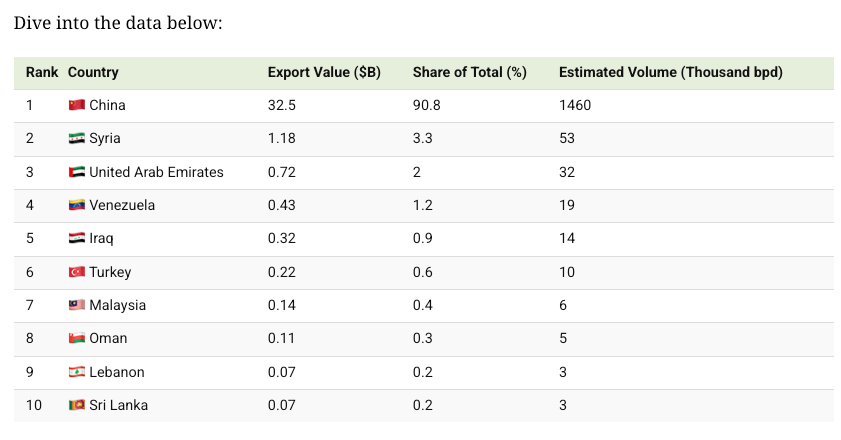
Iran’s Oil Exports by Country (2024)
90% of Iran’s Oil was exported to China: