

Q: Are you familiar with the story of the nation of Israel’s captivity in Egypt, as recounted by the Bible? In this story, the Egyptians killed the first-born Israelite male infants. (Gemini)
A: In the biblical account (book of Exodus), Pharaoh ordered the death of all newborn Israelite boys—not just the firstborn—by commanding that they be thrown into the Nile River. The specific targeting of the firstborn occurs later in the story as a plague directed against the Egyptians.
The Decree Against Israelite Infants
The Reason: Fearing that the enslaved Israelite population was becoming too large and powerful, Pharaoh sought to curb their numbers.
BibleRef.com
The Command: Pharaoh initially instructed the Hebrew midwives, Shiphrah and Puah, to kill newborn male babies at birth. When they refused out of fear of God, Pharaoh issued a command to all his people: every newly born Israelite boy was to be thrown into the Nile River, while female infants were allowed to live.
BibleRef.com+ 1
The Impact: This decree forms the backdrop for the birth of Moses, whose mother hid him in a basket along the riverbank. He was subsequently discovered and adopted by Pharaoh’s daughter.
BibleRef.com+ 1
The Plagues and the Death of the Firstborn
The Tenth Plague: Near the end of the captivity narrative, God sent a tenth and final plague upon Egypt (Exodus 11–12). In this event, the Egyptian firstborn male in every family—from Pharaoh’s royal heir down to the firstborn of captives and livestock—died at midnight.
Tom’s Theology Blog+ 1
Passover: The Israelites were instructed to mark their doorposts with the blood of a sacrificed lamb. The destruction “passed over” the homes with the blood mark, sparing the Israelite firstborn sons. It was this event that finally prompted Pharaoh to release the Israelites from slavery.
Jewish Theological Seminary
Q: Would you like to explore the narrative of Moses’ birth and early life in Egypt?
Yes
Would the Egyptian killing of all newborn males be classified as a “genocide” using the modern definition of “genocide” passed shortly after World War II?
A: Yes, Pharaoh’s command to kill all newborn Israelite males fits the modern legal definition of genocide established by the 1948 United Nations Convention on the Prevention and Punishment of the Crime of Genocide.
Legal Alignment with the 1948 UN Convention
Article II of the UN Convention defines genocide as specific acts committed with the “intent to destroy, in whole or in part, a national, ethnical, racial or religious group.” Pharaoh’s decree fulfills both the mental requirement (mens rea) and physical actions (actus reus):
Targeted Intent (Mens Rea): Exodus 1:9–10 explicitly records Pharaoh’s motive: fear that the growing Israelite population posed a security threat. The policy targeted Israelites specifically as a distinct national and ethnic demographic, with the objective of reducing their numbers and neutralizing their future strength.
Killing Members of the Group (Article II(a)): Ordering all male infants thrown into the Nile constitutes direct, systematic murder targeting group members based on identity.
Preventing Group Survival and Births (Article II(d)): Systematically destroying all male infants in a generation renders natural reproduction impossible for the group’s women in the future. This forces demographic absorption into the dominant Egyptian population, achieving the partial or total physical and cultural destruction of the group over time.
Systemic and Societal Impact
Evaluating the policy by its overall outcomes highlights why modern international law classifies such actions as the highest tier of atrocity:
Destruction of Aggregate Potential: Annihilating an entire generation of males eliminates all future well-being, innovation, productivity, and social flourishing those individuals would have contributed over their lifespans.
Widespread Mental Anguish: The trauma inflicted on families and the broader community creates severe, lingering suffering across the entire population, far outweighing any real or perceived administrative benefit.
Extreme Asymmetry of Utility: Pharaoh attempted to preserve state security and economic exploitation (slave labor). However, achieving marginal security for one group by inflicting total devastation and mass loss of life on another results in a catastrophic net loss to overall human well-being.
By modern standards, policies designed to engineer the collapse of an ethnic population through targeted mass murder meet every criterion of genocide.
Q: Would you like to examine how other ancient conflicts compare to modern legal definitions of war crimes?
yes
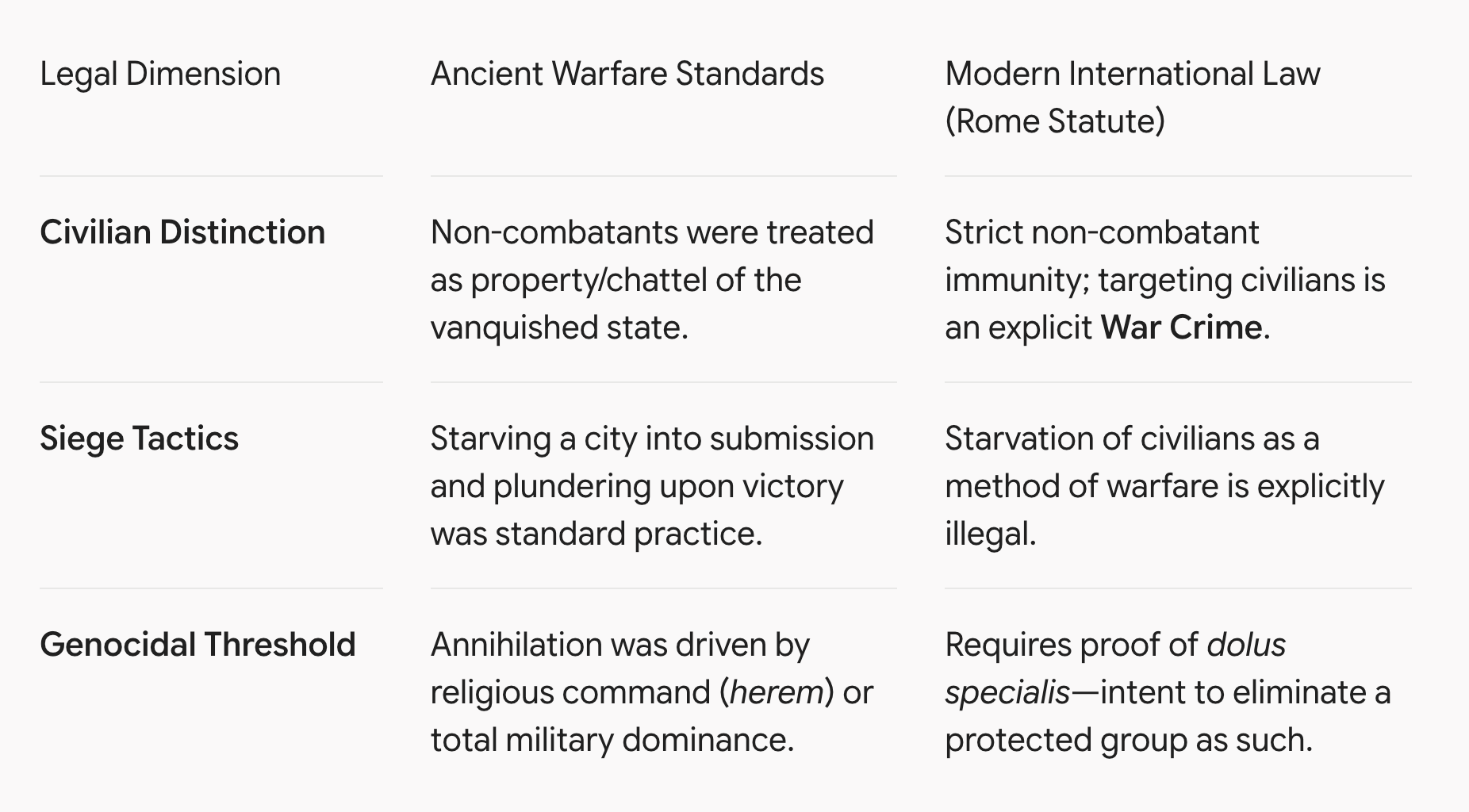
A: Evaluating ancient historical and biblical conflicts using modern international law—specifically the 1948 UN Genocide Convention, the Geneva Conventions, and the 1998 Rome Statute—requires treating these modern legal codes as an analytical heuristic rather than active historical standards. In antiquity, total warfare, siege starvation, collective punishment, and forced enslavement were standard rights of conquest (jus gentium), whereas modern humanitarian law centers on non-combatant immunity and specific intent (mens rea).
Global Centre for the Responsibility to Protect
Biblical Accounts
The Command Against Amalek (1 Samuel 15, Deuteronomy 25):
Textual Narrative: Israel is commanded to “utterly destroy” Amalek, killing men, women, children, infants, and livestock.
Modern Classification: Genocide (Rome Statute Article 6). The explicit directive to eliminate a specific ethnic group down to infants satisfies the strict legal threshold of dolus specialis—the aggravated criminal intent to destroy a protected group in whole or in part.
The Conquest of Canaan (Herem / Deuteronomy 20):
Textual Narrative: The decree of herem mandated the total extermination of all human life in designated cities so the native inhabitants would not influence Israel’s religious practices.
Modern Classification: Genocide and War Crimes. This combines identity-targeted annihilation with the modern absolute prohibition against targeting non-combatants.
The Campaign Against Midian (Numbers 31):
Textual Narrative: Israelite forces kill all adult males in battle, then execute captured women and male children, taking virgin females as captive property.
Modern Classification: War Crimes (execution of non-combatants and prisoners of war) and Crimes Against Humanity (enslavement, forcible transfer, and sexual violence).
Classical Antiquity Conflicts
The Destruction of Melos (416 BCE – Peloponnesian War):
Historical Event: Athens demanded that the neutral island of Melos submit to its empire. When Melos refused, Athens executed all adult male citizens and enslaved the women and children.
Modern Classification: Crimes Against Humanity (systematic mass murder and enslavement) and War Crimes. Modern courts would likely classify this as Crimes Against Humanity rather than Genocide, because Athens acted out of geopolitical subjugation (realpolitik) rather than intent to eradicate the Melian people based on their ethnic identity.
Wikipedia
The Fall of Carthage (146 BCE – Third Punic War):
Historical Event: Rome besieged Carthage for three years, causing catastrophic starvation. Upon breaching the walls, Roman forces slaughtered hundreds of thousands of civilians, enslaved the surviving ~50,000, and demolished the city.
Modern Classification: Crimes Against Humanity (extermination, mass murder, enslavement) and War Crimes (wanton destruction of cities not justified by military necessity).
Assyrian Imperial Conquests (8th–7th Century BCE):
Historical Event: The Neo-Assyrian Empire routinely used public execution, flaying, impalement, and mass population deportations (such as the exile of the Northern Kingdom of Israel) as systematic tools of imperial rule.
Modern Classification: Crimes Against Humanity (forcible transfer of populations, systemic torture, extermination).
Questions:
Are you surprised that Pharaoh’s murder of all newborn males would be considered genocide by the 1948 Convention that defines “Genocide”? If so, why didn’t you consider it genocide?
Are you surprised by the classification of Roman and biblical genocides and war crimes?
What is your opinion on how the Genocide Convention is policed? Is it working? Could it be done better?
World War II Genocide?
Would the American bombing of Dresden and Tokyo be considered genocide by standards of the 1948 convention?
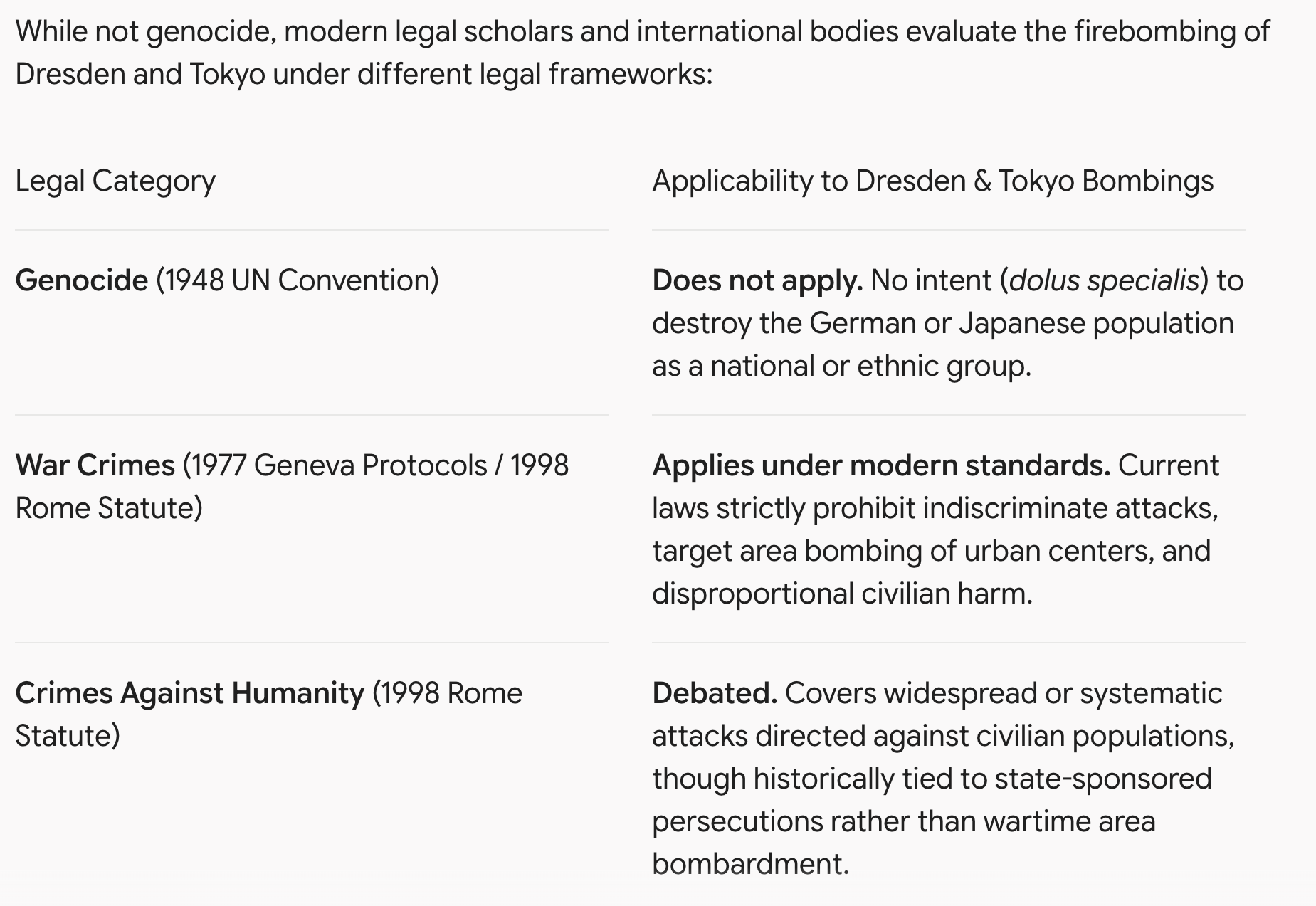
No, the American and Allied firebombings of Dresden and Tokyo would not be classified as genocide under the standards of the 1948 UN Convention on the Prevention and Punishment of the Crime of Genocide.
While these campaigns caused immense civilian death and physical destruction, they lack the specific legal criteria required to meet the definition of genocide.
ACC.af.mil - Air Force
Why the Bombings Do Not Qualify as Genocide
Article II of the 1948 UN Genocide Convention defines genocide as specific acts committed with the “intent to destroy, in whole or in part, a national, ethnical, racial or religious group, as such.”
OFFICE OF LEGAL AFFAIRS | - the United Nations
Absence of Genocidal Intent (Dolus Specialis): International law requires proof of a specific intent to physically eradicate a group because of their identity. The primary objectives in Dresden and Tokyo were military, economic, and political: destroying industrial supply chains, disrupting transportation hubs, breaking enemy morale, and forcing unconditional surrender to end World War II.
Post-War Policy: The Allied goal was regime change, demilitarization, and political restructuring, not the biological or physical destruction of the German or Japanese peoples. The subsequent Allied occupation, economic rebuilding, and integration of Germany and Japan into the international system directly contradict the threshold of genocidal intent.
Scale vs. Intent: Under international law, massive casualties and total urban destruction do not automatically constitute genocide unless the driving purpose is group annihilation.
How Modern International Law Categorizes the Bombings
The WWII Legal Context
During World War II, specific international treaties explicitly prohibiting aerial bombardment of cities did not yet exist (the 1907 Hague Conventions only covered land and naval bombardment of undefended towns). Consequently, neither Allied nor Axis commanders were prosecuted for strategic aerial bombing at the Nuremberg or Tokyo war crimes trials.
Under contemporary international humanitarian law—specifically Protocol I (1977) to the Geneva Conventions—the firebombing of population centers without distinguishing between military targets and civilians is explicitly recognized as a war crime.
Would you like to explore how the 1977 Geneva Protocols reformed the rules surrounding aerial bombardment?