

Here’s a meme from Twitter:
CLAIM: ‘It’s other countries’ fertiliser that’s stranded in the Persian Gulf, not our fertiliser.’
REALITY: Does one single official in this ridiculous administration understand that global supply contractions raises prices in America?

Rubio: This is a favor to the world because it is their ships that are stranded .. (18 sec)
COMMENTS:
1) That fact aside, does not a single official, not even the top diplomat, realize how counterproductive this “screw the rest of the world” attitude is?
2) Yes, it is other countries’ fertiliser stranded in the Persian Gulf because you started this illegal war. It’s your duty to sort out the mess you created.
3) I thought they were needing a replacement for having lost the Canadian vital potash to other countries.
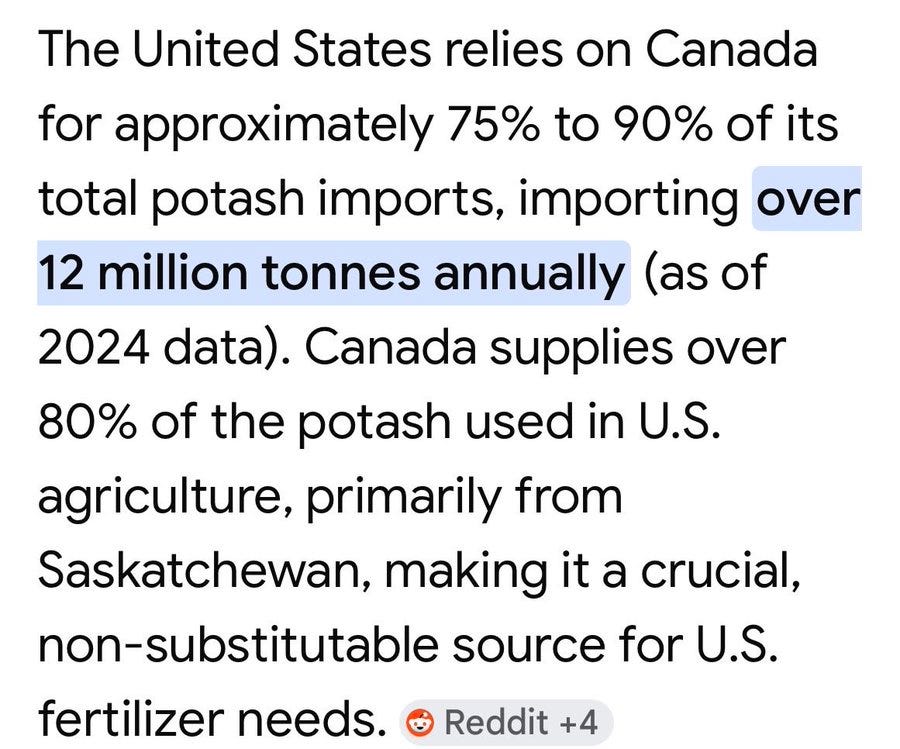
Question:
What do you think will be the consequences for the US due to its War on Iran and (alleged) indifference to it effects on allies?
What will be the consequences for those with the least food security?
What should Americans and Canadians do to help the food insecure? Is it recommended that those who can afford to not eat cheaper food (what economists call inferior goods) because it increases competition (and prices) for cheaper foods?
Elsewhere:
Nature (summary)
The article “How fertilizer shortages caused by the energy crisis threaten food security,” published in Nature (May 2026), examines the critical intersection of global energy markets, agricultural production, and food stability.
Core Summary
The paper details how the recent global energy crisis has triggered a “triple challenge”: threatening food security, accelerating environmental degradation, and complicating climate change mitigation. Because the production of synthetic fertilizers—particularly nitrogen—is highly energy-intensive, spikes in natural gas prices have led to severe fertilizer shortages and price hikes, disproportionately affecting developing regions.
Key Findings & Themes
Energy-Fertilizer Link: The study highlights that the cost and availability of nitrogen fertilizers are inextricably linked to energy prices. Shortages have led to reduced crop yields, particularly in “breadbasket” regions, straining the global food supply.
Regional Inequality: Africa is identified as the most vulnerable region, with nearly 21.3–24.4% of the population suffering from undernourishment. The article identifies three primary drivers of the current food crisis:
Conflicts: Responsible for 45.9% of the population in need.
Extreme Weather: Accounting for 28.8%.
Economic Shocks: (Including energy/fertilizer costs) accounting for 25.3%.
The Subsidy Paradox: The researchers analyzed agricultural subsidies (like India’s PMGKAY). While these programs expanded to record levels (up to 24.9% of agricultural budgets in 2020) to buffer farmers from costs, they have remained “structurally high,” potentially draining funds from health, education, and rural development.
Need for Efficiency: The authors argue that technological innovation alone isn’t enough. Improving Nitrogen Use Efficiency (NUE) is critical, but its success depends on poorly understood socio-economic factors and a shift toward decentralized, digital monitoring of food supply chains.
Proposed Solutions
The article advocates for a move toward Integrated Soil Fertility Management, which combines limited chemical fertilizers with organic inputs (manure, compost) to maintain soil health and reduce dependence on volatile energy markets.
Video not found: Why fertilizer price impacts food security This video provides a helpful visual explanation for how natural gas is used to create fertilizer and why energy price spikes directly lead to higher grocery bills and food shortages.