

In talking with a friend, I realized that some Americans are unaware of Russia’s history of being invaded by the West, and how that shapes its outlook. In the past, Russia has relied on “strategic depth” and its harsh climate to repel invaders.
Strategic depth is a term in military literature that broadly refers to the distances between the front lines or battle sectors and the combatants’ industrial core areas, capital cities, heartlands, and other key centers of population or military production.
In the War of 1812, the Russians relied on a tactic of Retreat that resulted in Napoleon crossed the Neman river in Poland on June 24, 1812, but it didn’t reach Moscow until September 4. The Russians burned Moscow to the ground, preventing the French from staying there the winter. As the French retreated, the fierce winter conditions decimated their ranks.
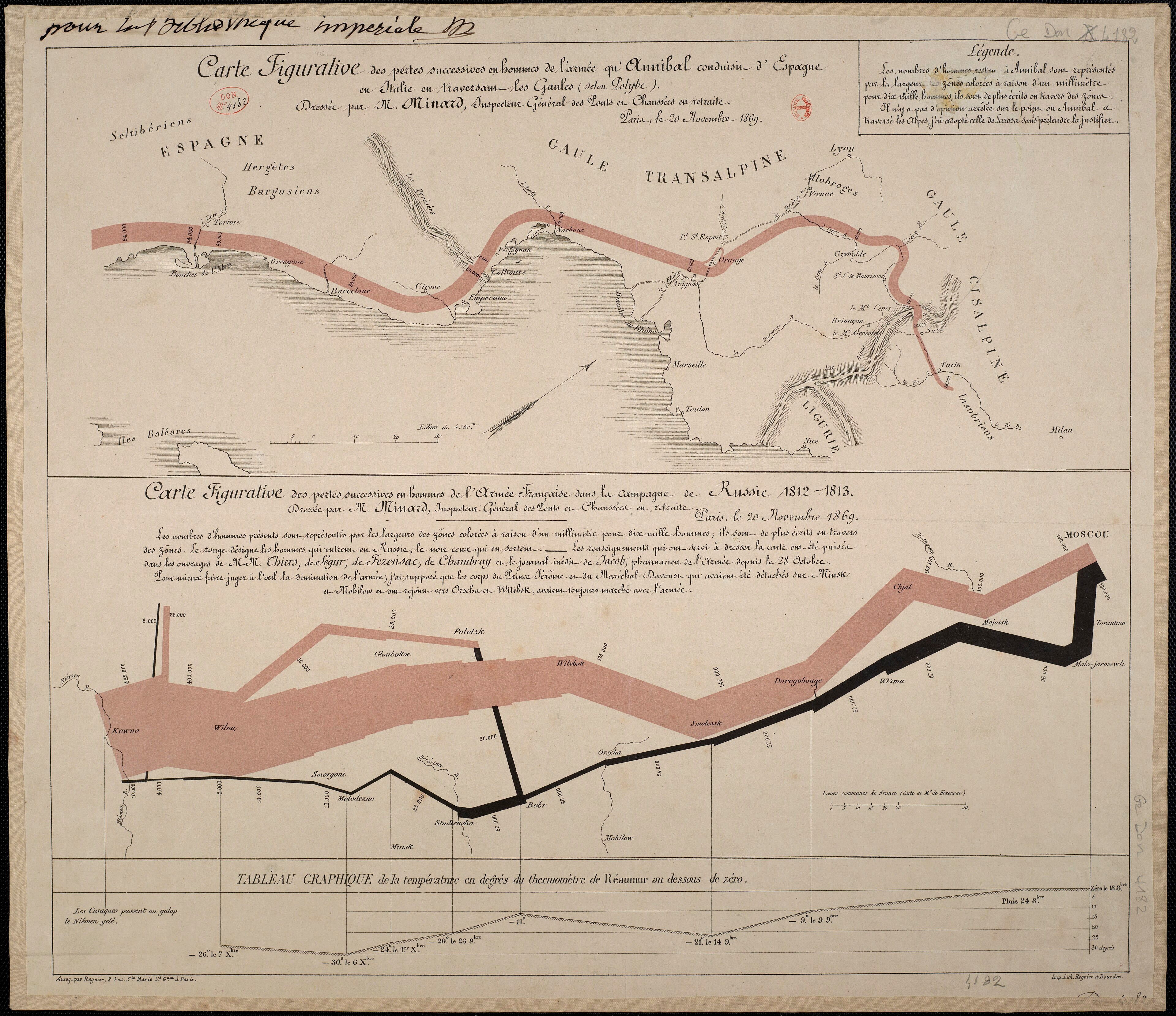
Infographic: Napoleon’s Losses, War of 1812
This Classic Infographic shows how Napoleon started out his military campaign with over 480,000 men (lower left), lost over 350,000 before arriving at Moscow, and then return to France with only 20,000!
Imagine the army represented by a red-colored “river” of men, traveling (originally from France to) Poland to Moscow. Moscow is located in the far right. As the “river of men” travel, they lose soldiers to disease, cold, and battle. The river changes color to black when the French arrive at Moscow, only to find the Russians had burned it to the ground as a poisoned chalice,1 and are then were forced to retreat, returning with a narrow sliver of black — arriving in France with 20,000 of the original 480,000 men. 2
Russia is much more vulnerable than the US to invasion because US has the Atlantic and Pacific to the east and the west and friendly governments of Canada and Mexico to the north and the south, while Russia is vulnerable in 9 ways because it lies on a plain with access from the west.
The Russians have been very concerned that the US/NATO is reducing its strategic depth.
History of Invasions of Russia
Kirsk campaign, Ukraine + NATO support, 2024-25
WWII 1941-1945
WWI Eastern Front, 1914-18
Crimean War, British, Ottoman, French, 1853
QUESTIONS:
Were you aware of Napoleon’s 1812 invasion of Russia and the role that strategic depth and climate shaped events?
Are you are aware of how Russia’s history of large-scale invasion and geography influences its military strategy today?
Did you understand how unusually favorable the US geography is in isolating the country from invasion?
Famous Art:
Tchaikovsky | 1812 Overture (sometimes played on July 4, with cannons fired)
Tolstoy: War & Peace (classic novel)
DETAIL:
Wikipedia: Invasion of Russia
Widely studied, Napoleon’s incursion into Russia remains a focal point in military history, recognized as among the most devastating military endeavors to ever unfold.[23] In the span of less than six months, the campaign claimed the lives of around a million soldiers and civilians.[24][22]
Beginning on 24 June 1812, the initial wave of the multinational Grande Armée crossed the Neman River, marking the entry from the Duchy of Warsaw into Russia. Employing extensive forced marches, Napoleon rapidly advanced his army of nearly half a million individuals through Western Russia, encompassing present-day Belarus, in a bid to dismantle the disparate Russian forces led by Barclay de Tolly and Pyotr Bagration totaling approximately 180,000–220,000 soldiers at that juncture.[25][26] Despite losing half of his men within six weeks due to extreme weather conditions, diseases and scarcity of provisions, Napoleon emerged victorious in the Battle of Smolensk. However, the Russian Army, now commanded by Mikhail Kutuzov, opted for a strategic retreat, employing attrition warfare against Napoleon compelling the invaders to rely on an inadequate supply system, incapable of sustaining their vast army in the field.
In the fierce Battle of Borodino, located 110 kilometres (70 mi) west of Moscow, Napoleon was not able to beat the Russian army and Kutuzov could not stop the French. At the Council at Fili Kutuzov made the critical decision not to defend the city but to orchestrate a general withdrawal, prioritizing the preservation of the Russian army.[27][c] On 14 September, Napoleon and his roughly 100,000-strong army took control of Moscow, only to discover it deserted, and set ablaze by its military governor Fyodor Rostopchin. Remaining in Moscow for five weeks, Napoleon awaited a peace proposal that never materialized..
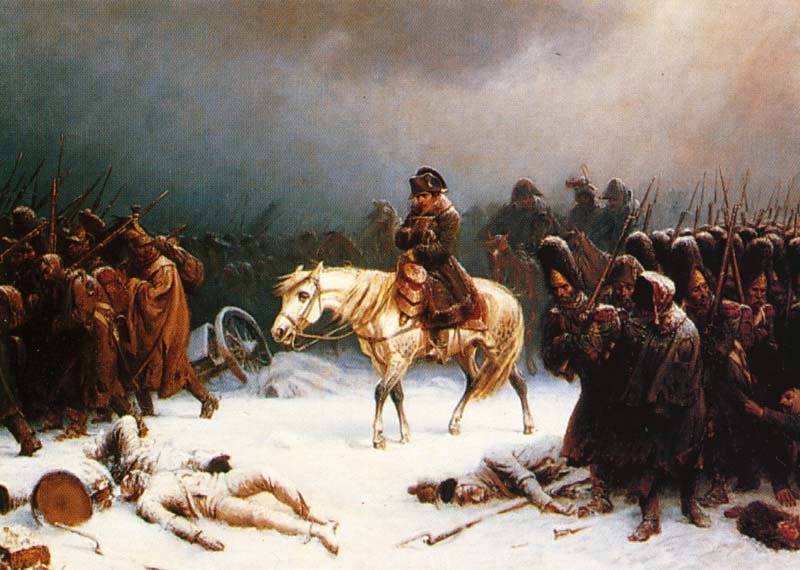
As early November arrived, snowfall and frost complicated the retreat. Shortages of food and winter attire for the soldiers and provision for the horses, combined with guerilla warfare from Russian peasants and Cossacks, resulted in significant losses. More than half of the soldiers perished from starvation, exhaustion, typhus, and the unforgiving continental climate.
.. Despite the consolidation of several retreating French corps with the main army, by the time he reached the Berezina river, Napoleon commanded only around 49,000 troops alongside 40,000 stragglers of little military significance. On 5 December, Napoleon departed from the army at Smorgonie in a sled and returned to Paris. Within a few days, an additional 20,000 people succumbed to the bitter cold and diseases carried by lice.
.. Napoleon's initial force upon entering Russia exceeded 450,000 men,[32] over 150,000 horses,[33] approximately 25,000 wagons, and nearly 1,400 artillery pieces. However, the surviving count dwindled to 120,000 men (excluding early deserters),[d] signifying a staggering loss of approximately 380,000 lives (dead or missing/prisoner) throughout the campaign, half from diseases.[35][36] This catastrophic outcome shattered Napoleon's once-untarnished reputation of invincibility (Wikipedia)
Footnotes:
The French set their destination for Moscow, hoping to conquer Russia and then loot the capital, feeding off the supplies there over the winter.
“Taking the French annexation of the German Duchy of Oldenburg as a pretext, he declared war on 8 April 1812. In June, Napoleon invaded Russia with a force of 480,000, keeping in reserve another 120,000 soldiers. The Russian tactics centred on refusing battle, disrupting the French forces and forcing them to spread out and become dispersed.
The French easily took Vilnius and then Smolensk but on 7 September, neither Napoleon nor Koutousov emerged victorious from the battle of Borodino, at the gates of Moscow. A week later, the French entered a city soon to be consumed in flames; the Russians had sacrificed it in order to destroy any supplies or ammunition from which the French could have profited.
Napoleon thus began his retreat on 18 October. The army experienced great difficulty in crossing the swollen Berezina (a river in Belarus) 28-29 November, and Napoleon, warned of a possible coup d’état in Paris, was forced to push on ahead. He left Ney and Murat in charge of the remaining troops, but the horrendous weather conditions meant that only 20,000 soldiers returned to France alive”
https://www.napoleon.org/en/young-historians/napodoc/timeline-consulate1st-french-empire/