

Tim’s Summary:
University of Chicago professor Robert Pape is doing a series of interviews with Breaking Points in which he describes how Trump’s conflict with Iran fits with his concept of “The Escalation Trap.” (See Summary Below)
Pape suggest this conflict could go on for a long time. I’ve heard estimates of two years.
US’s next 3 Rivals:
To take a bigger picture perspective, Pape sees this control over the Strait of Hormuz as the emergence of Iran as a 4th major world power:
US
China
Russia
Iran
(Note: the US’s next three competitors are all allied against it)
The US and Israel have launched repeated attempts to suppress Iran, ranging from:
sanctions, to
assassinations, to
military strikes.
Backfire: Regime Change: Fatwa lifted?
The former supreme leader Ayatollah Ali Khamenei issued a fatwa prohibiting the development of nuclear weapons. Killing him means Iran is more likely to acquire nuclear weapons, not less.
Backfire: “A Whole Civilization will die tonight”
Pape says that President Trump’s threat that “a whole civilization will die tonight” will not be soon forgotten by the rest of the world. It constitutes “‘clearer evidence of genocidal intent’ " than almost any other historical example” (see footnote below @7:04) and Professor Pape suggests it may change European leaders’ willingness to allow their nuclear weapons to be controlled by the US.
What is “The Escalation Trap”: (AI)
The Escalation Trap, a concept extensively analyzed by political scientist Robert Pape, refers to a strategic dilemma often found in asymmetric conflicts or suicide terrorism. It describes a situation where a state’s response to an attack inadvertently fuels the very cycle of violence it intends to stop.
Pape’s work, particularly in Dying to Win: The Strategic Logic of Suicide Terrorism, suggests that terrorists use violence to provoke a heavy-handed state reaction, which then serves their long-term political goals.
How the Trap Functions
The trap operates on a specific psychological and political loop:
The Provocation: A non-state actor (or weaker power) carries out a high-profile, shocking attack against a much stronger state.
The Compelled Response: The state, facing domestic pressure to ensure security and project strength, responds with massive military force or broad security crackdowns.
The Radicalization: This heavy-handed response—often involving civilian casualties or perceived “occupier” behavior—alienates the local population.
The Recruitment Boom: The resentment caused by the state’s response provides the terrorist group with more recruits, funding, and legitimacy, making the group stronger than it was before the initial attack.
Key Components of Pape’s Theory
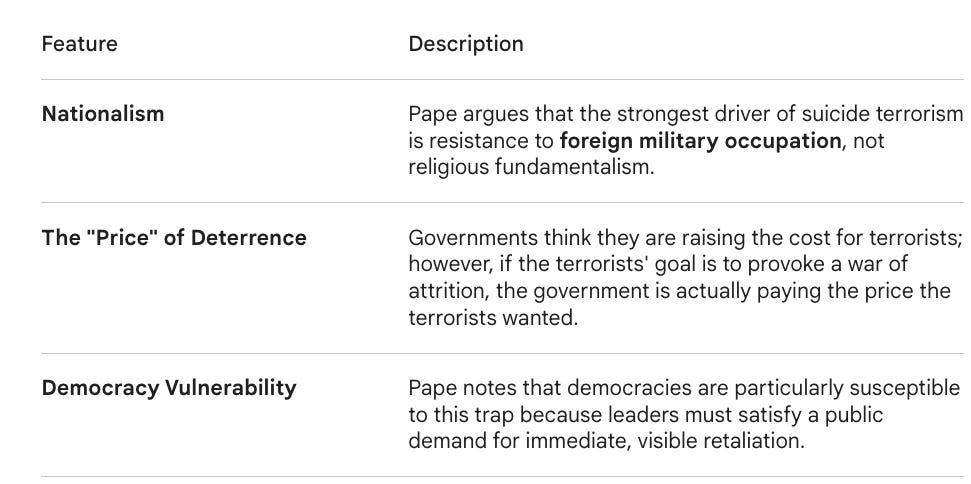
Why It’s Effective
The “trap” is successful because it forces a stronger power to choose between two losing options:
Doing nothing: This makes the government look weak and encourages further attacks.
Escalating: This leads to “mission creep,” economic drain, and the radicalization of a new generation of adversaries.
Conclusion
Robert Pape’s analysis serves as a warning for policymakers. He suggests that the most effective way to avoid the escalation trap is to move away from heavy military footprints in foreign lands—which he views as the primary “oxygen” for these conflicts—and instead focus on offshore balancing and targeted intelligence rather than broad-scale occupation.
Professor Pape Interview (AI)
The uploaded text is a transcript of an interview with Robert Pape, a professor at the University of Chicago and author of the Substack The Escalation Trap. Pape argues that despite a tenuous ceasefire, the United States, Israel, and Iran remain in a dangerous geopolitical “trap” that is fundamentally shifting the global balance of power.
The Escalation Trap and Nuclear Ambitions
Pape contends that the conflict has not ended but has entered a phase where the threat of escalation is higher than ever.
Failed Deterrence: Pape argues that military strikes (such as “Midnight Hammer”) have only provided temporary stopgaps, as Iran continues to rebuild its missile and drone supplies at a rate of 50 to 100 per month.
Nuclear Incentive: Iran currently possesses enough enriched uranium for 10 to 16 nuclear weapons. Pape believes Iran is now “maximally incentivized” to conduct nuclear tests within the next six to twelve months to protect itself from existential threats.
Public Support: While only 16-20% of Iranians supported the regime before the bombing, Pape suggests that Donald Trump’s threats of “total destruction” have unified the population of 92 million behind the regime’s weapons programs for their own survival.
Shift in the Balance of Power
A central theme of the interview is the emergence of Iran as a major global power.
Regional Hegemony: Pape argues that the ceasefire terms demonstrate a new hierarchy where Iran, not the U.S., is the dominant power in the Middle East. He points out that the U.S. now effectively requires Iranian permission for ships to pass through the Strait of Hormuz.
The “Fourth Power Center”: Pape posits that Iran is becoming the fourth center of world power alongside the U.S., Russia, and China. He notes that these three nations are structurally incentivized to cooperate against U.S. interests.
Economic Resilience: Despite sanctions, Iran generates $75 to $100 billion annually through Chinese banks, providing the resources necessary to reconstitute its military.
Consequences of Rhetoric and Policy
Pape expresses deep concern over President Trump’s recent statements regarding the potential destruction of Iranian civilization.
Genocidal Intent: Pape argues that Trump’s rhetoric provides “clearer evidence of genocidal intent” than almost any other historical example,1 potentially violating the Geneva Accords.
Strained Alliances: He suggests that such rhetoric may lead NATO allies, such as Britain, to reconsider allowing the U.S. to control their nuclear assets.
Israeli Insecurity: Pape warns that the shifting balance of power and the incentivization of regional nuclearization will leave Israel—surrounded by 500 million Muslims—in a dramatically more vulnerable position.
Critique of “Victory” Narratives
Pape dismisses claims that Iran’s military and infrastructure are in ruins. He characterizes Donald Trump’s suggestion of a “joint venture” with Iran to collect tolls in the Strait of Hormuz as being “not on planet Earth,” arguing that nations will prioritize their actual security over “photo ops”.
Original Context: “I don’t think there could be a clearer evidence of genocidal intent than you just saw”
5:42 “Secretary Hegseth, he sees right away that there’s been no disincentive here and he’s saying we’re gonna take the material. Well, Iran, I think, is not just going to hand it over. This is how are they going to stop the next nuclear threat by Donald Trump. There’s only one way now, which is nuclear weapons with a nuclear test and probably several nuclear tests to just rub it into America’s face. You nuke us, we’re coming back. And so, you mentioned that Trump saying that, you know, tonight a great civilization is going to die. uh that that is going to leave a permanent or at least a very long-term mark on our geopolitics. Can you explain how you mean that? Yeah. So, we need to understand that no president in the history of the United States has made a statement uh threatening to erase, destroy, kill an entire civilization. Point number one, that is the evidence of genocidal intent that’s required in the Geneva Accords to convict for genocide. We need to understand that the genocide uh accords that we have um they’re about the intent to commit genocide. Usually, that’s the hardest thing to find. It’s not the killing of people, it’s the intent.
7:04 Well, President Trump, I don’t think there could be a clearer evidence of genocidal intent than you just saw. Number two, President Trump is one of only a handful of people on the planet with enough nuclear weapons that he would be able to actually execute that threat. So, um, with we have 500 Minutemen missiles, uh, and they have warheads with 300,000 kilotons on them. Hiroshima Nagasaki was only 10 12 to 22 kilotons. So, these are much much more powerful than Hiroshima Nagasaki. and we have 500 of them and within 45 minutes their gyroscopes can be reoriented to Iran. 20 minutes after that all that uh those all of those 500 can land on Iran. So I I’m sorry to be so blunt but we need to really understand that what Donald Trump has done here is it’s uh it’s immoral. It it is very likely I’m not a lawyer very likely uh contradict the Geneva Accords. Uh but it’s also dangerous because now every American is marked here and this will be wherever we travel in the world. Um about to maybe get on a plane to go to London here. This is uh this is not trivial. And so what you’re seeing is now 92 million uh Iranians, not just these tiny number of, you know, supreme leaders, uh they’re pretty maximally, uh incentivized to show that there’s uh some payback that can come. So this is really an enormously uh consequential move by uh President Trump and it will do no good that he will somehow maybe take it back or his supporters will say it’s just Trump being Trump. No, I’m sorry. Um, not everybody not everybody who’s a drunk at a bar has their finger on thousands of nuclear weapons that can be delivered within a matter of an hour or less as I’m explaining in detail. This is way too consequential and this will have tremendous ripple effects across the world. Our allies, the idea our allies will in Europe will let us even uh run NATO. NATO we need to understand it is a military organization where when the American general runs the operation of a NATO military operation it’s the American general who controls the nuclear weapons of Britain. Do you think Britain is going to go for that at this? I mean, my Yeah, you can see right away n so the the rip the consequences here are way beyond um what’s and and then in the straight of Hormuz the consequences are there’s a new hierarchy of power. Donald Trump just cowtowed to Iran essentially. There’s a new hierarchy and everybody in the Middle East will see that. NBS will know there’s no Donald Trump cavalry coming to save him. So that’s Saudi Arabia. So you’re seeing these these gigantic consequences of what’s happened are consequences uh for all Americans. They’re consequences for the world balance of power. Iran is becoming the fourth center of world power.”