

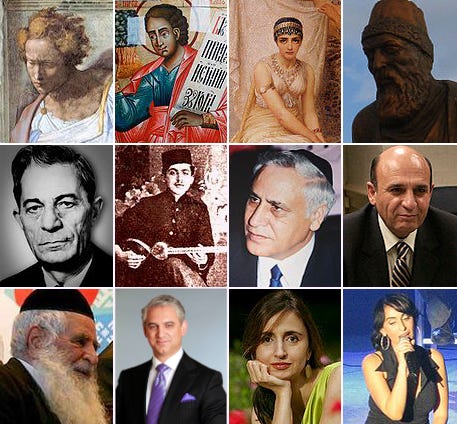

Wikipedia: Iranian Jews
Iranian Jews[4][a] constitute one of the oldest communities of the Jewish diaspora. Dating back to the biblical era, they originate from the Jews who arrived in Iran as Babylonian captives. Books of the Hebrew Bible (i.e., Esther, Isaiah, Daniel, Ezra, and Nehemiah) bring together an extensive narrative shedding light on contemporary Jewish life experiences in ancient Iran; there has been a continuous Jewish presence in Iran since at least the time of Cyrus the Great (the 6th century BCE), who led the Achaemenid army’s conquest of the Neo-Babylonian Empire and subsequently freed the Judahites from the Babylonian captivity.
History
Jews had been residing in Persia since around 727 BC, having arrived in the region as slaves after being captured by the Assyrian and Babylonian kings. According to one Jewish legend, the first Jew to enter Persia was Serah bat Asher, granddaughter of the Patriarch Jacob.[8] The biblical books of Isaiah, Daniel, Ezra, Nehemiah, Chronicles, and Esther contain references to the life and experiences of Jews in Persia and accounts of their relations with the Persian kings. In the book of Ezra, the Persian kings are credited with permitting and enabling the Jews to return to Jerusalem and rebuild their Temple; its reconstruction was effected “according to the decree of Cyrus, and Darius, and Artaxerxes king of Persia” (Ezra 6:14). This great event in Jewish history took place in the late sixth-century BC, by which time there was a well-established and influential Jewish community in Persia.
Jews in ancient Persia mostly lived in their own communities. Iranian Jews lived in the ancient (and until the mid-20th century still extant) communities not only of Iran, but also the Armenian, Georgian, Iraqi, Bukharan, Afghan and Mountain Jewish communities.[9][10][11][12]
Some of the communities have been isolated from other Jewish communities to the extent that their classification as “Persian Jews” is a matter of linguistic or geographical convenience rather than actual historical relationship with one another. Scholars believe that during the peak of the Persian Empire, Jews may have comprised as much as 20% of the population.[13]
According to Encyclopædia Britannica: “The Jews trace their heritage in Iran to the Babylonian Exile of the 6th century BC[E] and, like the Armenians, have retained their ethnic, linguistic, and religious identity.”[14] But the Library of Congress‘s country study on Iran states that “Over the centuries the Jews of Iran became physically, culturally, and linguistically indistinguishable from the non-Jewish population. The overwhelming majority of Jews speak Persian as their mother language, and a tiny minority, Kurdish.”[15]
Islamic Republic (1979–present)
At the time of the 1979 Islamic Revolution, 80,000–100,000 Jews were living in Iran. From then on, Jewish emigration from Iran dramatically increased, as about 20,000 Jews left within several months of the revolution alone.[47] The majority of Iran’s Jewish population, some 60,000 Jews, emigrated in the aftermath of the revolution, of whom 35,000 went to the United States, 20,000 to Israel, and 5,000 to Europe (mainly to the United Kingdom, France, Denmark, Germany, Italy, and Switzerland).[59][better source needed] Some sources put the Iranian Jewish population in the mid and late 1980s as between 50,000 and 60,000.[60] An estimate based on the 1986 census put the figure considerably higher for the same time, around 55,000.[61] From the mid-1990s to the present there has been more uniformity in the figures, with most government sources since then estimating roughly 25,000 Jews remaining in Iran.[62][63][64][65] These less recent official figures are considered bloated, and the Jewish community may not amount to more than 10,000.[66] A 2012 census put the figure at about 8,756.[67]
Ayatollah Khomeini met with the Jewish community upon his return from exile in Paris, when heads of the community, disturbed by the execution of one of their most distinguished representatives, the industrialist Habib Elghanian, arranged to meet him in Qom. At one point he said:
In the holy Quran, Moses, salutations upon him and all his kin, has been mentioned more than any other prophet. Prophet Moses was a mere shepherd when he stood up to the might of pharaoh and destroyed him. Moses, the Speaker-to-Allah, represented pharaoh’s slaves, the downtrodden, the mostazafeen of his time.
At the end of the discussion Khomeini declared, “We recognize our Jews as separate from those godless, bloodsucking Zionists”,[66] and issued a fatwa decreeing that the Jews were to be protected.[68]
Synagogues and Hebrew schools
See also: List of synagogues in Iran
Most Jews live in Tehran, the capital.[115] Today[when?] Tehran has 11 functioning synagogues, many of them with Hebrew schools. It has two kosher restaurants, an old-age home and a cemetery. There is a Jewish library with 20,000 titles.[73] Traditionally however, Shiraz, Hamedan, Isfahan, Tabriz, Nahawand, Babol and some other cities of Iran were home to large populations of Jews. Isfahan has a Jewish population of about 1,500, consisting mostly of businesspeople. As of 2015 there were 13 synagogues,[where?] including the primary synagogue on Palestine Square. In Esfahan, many Jewish businesses are concentrated in an area called “Jewish Passage”.[116]
.. Current status
Iran’s Jewish community is officially recognized as a religious minority group by the government, and, like the Zoroastrians and Christians, they are allocated one seat in the Iranian Parliament. Homayoun Sameh is the current Jewish member of the parliament, replacing Siamak Moreh Sedgh in the 2020 election. In 2000, former Jewish MP Manuchehr Eliasi estimated that at that time there were still 60,000–85,000 Jews in Iran; most other sources put the figure at 25,000.[78] In 2011 the Jewish population numbered 8,756.[79] In 2016 Jewish population numbered 9,826.[5] In 2019 the Jewish Population numbered 8,300[3] and they constitute 0.01% of Iranian population, a number claimed in 2017 by Sergio DellaPergola, a leading Jewish demographer.[80]
Iranian Jews have their own newspaper (called “Ofogh-e-Bina”) with Jewish scholars performing Judaic research at Tehran‘s “Central Library of Jewish Association”.[81] The Dr. Sapir Jewish Hospital is Iran‘s largest charity hospital of any religious minority community in the country;[81] however, most of its patients and staff are Muslim.[82]
Chief Rabbi Yousef Hamadani Cohen was the spiritual leader for the Jewish community of Iran from 1994 to 2007, when he was succeeded by Mashallah Golestani-Nejad.[83] In August 2000, Cohen met with Iranian President Mohammad Khatami for the first time.[84] In 2003, Cohen and Motamed met with Khatami at Yusef Abad Synagogue, which was the first time a President of Iran had visited a synagogue since the Islamic Revolution.[85] Haroun Yashayaei is the chairman of the Jewish Committee of Tehran and leader of Iran’s Jewish community.[85][86] On 26 January 2007, Yashayaei’s letter to President Mahmoud Ahmadinejad concerning his Holocaust denial comments brought about worldwide media attention.[87][88][89][90]
The Jews of Iran have been best known for certain occupations like making gold jewelry and dealing in antiques, textiles and carpets.[citation needed]
Read More: Full Wikipedia Article
QUESTIONS:
Did you remember the Jewish roots in Iran?
Are you surprised that there are still Jews living in Iran that are part of an officially recognized minority group?
How does the history of Jews in Iran compare to the history of Jews living in Europe?