

Why is it that the wealthiest people are often the hardest to notice?
The ultimate symbol of extreme wealth isn’t a flashy supercar. It’s spending $30,000 on a watch precisely because everyone else will assume it cost $50.
True wealth operates under a strict code of invisibility, because being visibly rich carries an enormous and exhausting social tax.
The moment a person’s net worth becomes obvious, they transition from a normal human being into a walking ATM. Relationships warp. Casual acquaintances suddenly have “can’t-miss” business propositions, distant relatives need emergency loans, and normal social interactions carry an undercurrent of financial expectation. Beyond the awkwardness, visible wealth attracts frivolous lawsuits, targeted scams, and physical security risks. The simplest way to avoid this friction is to hide in plain sight.
This necessitates a shift from loud luxury to “stealth wealth.” Loud luxury—oversized logos, flashy sports cars, and instantly recognizable designer prints—is designed to signal financial success to strangers. It is favored by those with high incomes but relatively low net worth, who still feel the need to prove their status.
The ultra-wealthy, who are securely post-economic, have nothing to prove. They trade recognizable branding for absolute material quality. A stealth wealth wardrobe might consist of a $2,000 Loro Piana cashmere sweater or a bespoke suit from Savile Row—items that look ordinary to the average person but are instantly recognizable to the few people who matter in their social stratum.
There is a distinct “if you know, you know” signaling mechanism at play. Consider the Patek Philippe Calatrava, often regarded as the quintessential luxury dress watch.
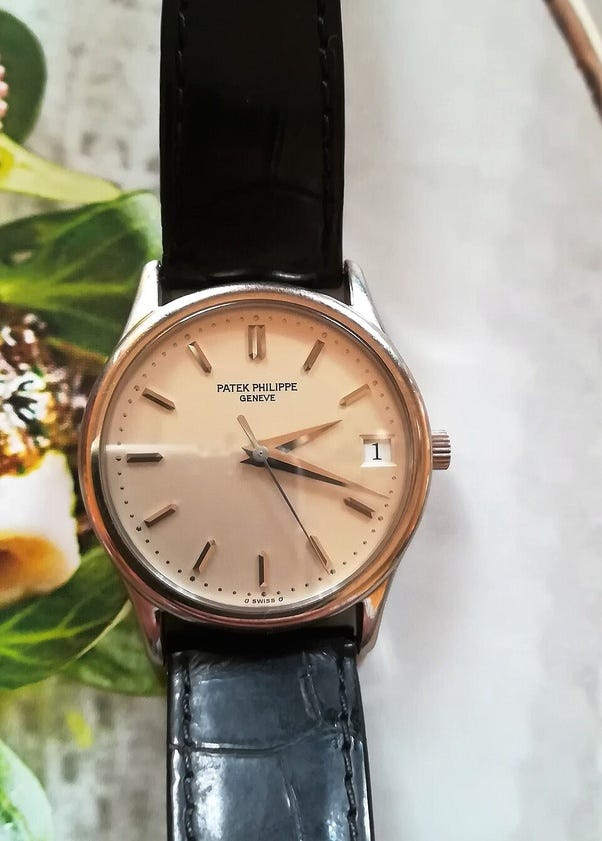
A Patek Philippe Calatrava features a champagne dial, gold baton hour markers, and a leather strap. - Photo by Clyde94 (Wikimedia Commons) is licensed under CC BY-SA 4.0

To most observers, it looks like a generic $50 watch you could buy at a department store. There are no diamonds, no massive dials, and no obvious branding visible from a distance. Yet, it retails for tens of thousands of dollars. By the time someone amasses enough capital to afford anything they want, they usually realize the most valuable commodity money can buy is the freedom to be ignored.
QUESTIONS:
What is the difference in outlook between the wealthy stealthy and those who wear a Rolex?
Is it really true that the stealthy wealthy have nothing to prove — “The ultra-wealthy, who are securely post-economic, have nothing to prove." — given that they don’t wear a $50 Timex? It seems that they still want to signal to others that they are part of the “club”?
Why not take the next step and wear a $50 watch and really go stealth?