

Or maybe this war isn’t about Iran. Maybe Professor Jiang is right that the attack on Iran is a pretext for an expansionary American “Forever War” ( WWIII)
Here is the argument that Iran is defeating the US:
First, Iran has the advantage in that it has to merely avoid defeat, while the US has to actually camp out in the region indefinitely1 in the hope that they can get Iran to surrender or agree to a set of terms. The US can only maintain the blockade for so long. Iran is like Vietnam in their willingness to sacrifice, and they merely have to play defense.
The Iranians have weathered past attacks, such as a nearly 8-year war with Iraq when the US supplied Saddam Hussein and Iraq with chemical weapons,2 along with the intel Iraq used to target Iranians. Contrary to their portrayal in American media, Iran didn’t respond to Iraq’s chemical weapons attacks in kind, with chemical attacks of their own. Only the side the US was supporting resorted to chemical weapons.****
Iran didn’t control the Strait of Hormuz before the War; now they do, in part. Some say controlling the Strait of Hormuz is even better than having a nuclear bomb.
Iran is allied with the Houthis, which can block trade via their control of the Strait on the Red Sea. The Strait of Bab-el-Mandeb is strategically even more significant than the Strait of Hormuz!
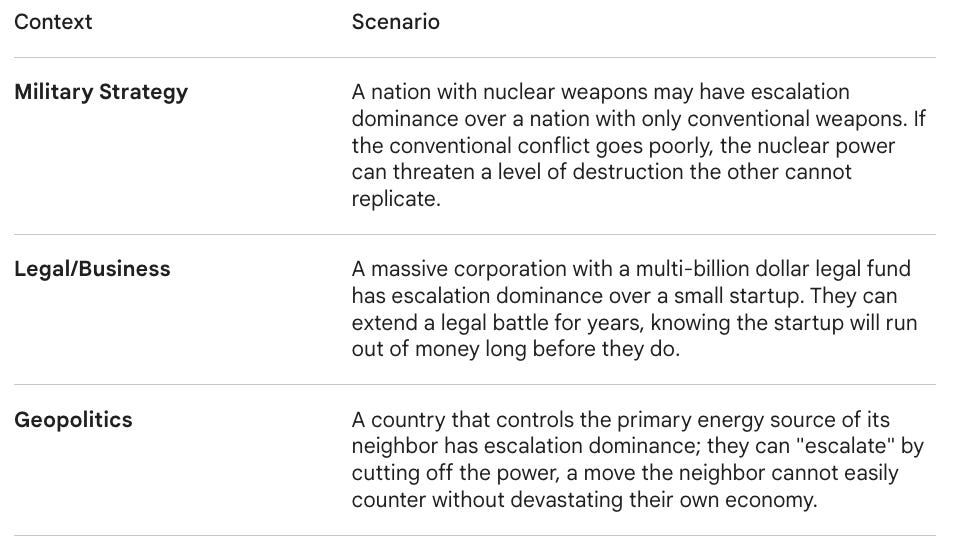
Iran has “escalation dominance”:3 4
Iran can destroy Gulf countries’5 oil and gas fields and infrastructure, knocking out Gulf energy resources for a number of years, leading to a global depression.
Such an attack would be devastating to the US and it’s allies, and ..
It would generate higher oil prices, which would actually benefit Iran and Russia.6
Being able to benefit financially when your opponent is losing is a very powerful strategic arrangement.
Iran could destroy Israeli and US Gulf allies’ desalination plants.
Gulf countries depend on their desalination plants for 60-80% of their potable water. This would force a mass exodus of people in a very short amount of time because societies can’t exist for long without.
Israel relies on desalination for between 55% amd 86% of its water, depending on the year. An attack on desalination plants would force many Israelis to flee and the question would then become — Would evacuees return to Israel? Escalation could lead to the demographic destruction of the state of Israel.
Iran destroyed Israel’s long-range radars, blinding Israeli air defenses.
Iran also destroyed critical US E-3 Sentry AWAC planes providing radar for US and Israeli planes.
Iran has more ammunition than US/Israel: The Iron dome does not have sufficient interceptors to shoot at least two interceptors for every incoming missile, which is standard practice when the Iron dome deals with incoming missiles.
Iran has an asymmetric manufacturing and cost advantage: The US and Israel have to spend up to 4 million dollars per intercepter,7 and use more than one intercepter per $20,000 — 50,000 drone.
The US supply chains don’t have the ability to quickly replenish interceptor inventories, even if we wanted to pay the ungodly amount of money to the military contractors.
Some crucial US systems depend upon rare earth minerals from China, and China is not keen on helping the US replenish these stocks.
Iran is able to keep US aircraft carriers 600 miles off the Iranian coast using drones and missiles. This makes it more challenging for the US to attack Iran because it takes extra flight time and refueling to travel the 1200 miles roundtrip to Iran. It also makes it harder for the US to contest the Strait of Hormuz.
Trump says that Iran’s navy was destroyed but Iran invested in an asymmetric approach that can send 100 drones at a carrier.***** The Iranian approach is effective and much cheaper, albeit not comparable in every way.
Trump said that the US destroyed the Iranian air force, but Iran didn’t have much of an air force to begin with. They had some planes from the 1960s, but Iran invested in missiles and drones instead. These drones and missiles were successful in breaching the Israeli Iron Dome, and they didn’t need an air force to do it.
The US has “air superiority” by virtue of the fact that Iran does not have an air force, but the Israeli and US air force attacks were not possible because they can roam freely over the Iranian countryside. Instead, they used stand off missiles with a range of 500 miles, fired at Iran from near the Iranian border. These missiles flew from outside of Iran, the rest of the way to the target under their own propulsion.
This is important because if the US wants to go deep into Iran and attack declared and suspected nuclear facilities, the US can’t go in uncontested like Trump pretends. The US risks more pilot/special forces rescues if they choose to fly over central cities and facilities.
Other US “cards” are overstated, such as the number of air defense installations that the US has destroyed. China provided Iran some high quality decoys**** that even generate their own heat signatures. The US risks its planes and resources attacking air defense and building decoys which cost a few thousand dollars, while American precision missiles can cost $2-3 million. Iranian/Chinese decoys and can be quickly restocked, unlike the US missiles, which have a slow and costly supply chain.8 ****
The goal is not a “conventional military defeat,” but rather .. the logistical and financial inability to continue a war that achieves no tangible results against real targets9
The US and Israel were hoping for a revolution which would overthrow the Iranian government. This relied on trained insurgents, communicating by Elon Musk’s Starlink satellite receivers.**** Iran was able to shut down the insurgents’ ability to receive coordinating messages and, even more, identify the insurgents themselves. The Israel/US-sponsored insurgency failed. Another option for dissatisfied Iranians would be to emigrate, but demand for that is not high, which one would think it would be, even in wartime, as there is no restriction against those who would want to leave via neighboring countries. ****
While it is in US interests its the military to leave the region, Trump will have to override the desires of Israel and his donors who want to destroy the state of Iran, divide it ethnically, and weaken it to the point that Israel can bomb it at will (what Israel calls “Mowing the Lawn”). I can imagine a scenario where pro-Israel supporters manipulate Trump using his “Winners/Losers” philosophy. I expect overcoming this psychological attack of “Losing” to be the most challenging aspect of Trump’s decision. Alister Crooke has said “Everyone knows that Trump needs a trophy.” Either that or Congress will have to take back its war-powers, but I’m not holding my breath on Congress.
QUESTIONS:
Which of the above reasons that the US is being defeated had you not heard of before reading this article and which do you think are the most significant?
What do you think of the Chinese strategy identified in the ModernDiplomacy article, of defeating the US through supply chains and finances?
Were you tricked by US propaganda regarding air superiority in Iran, or allegations of a destroyed navy and air force?
Were you aware that the US overthrew Mohammad Mosaddegh, Iran’s elected democratic leader in 1953 and backed Iraq’s 8-year war against Iran, starting in 1980, including Iraq’s use of chemical weapons against Iran?
What do you make about Footnote #6: Attacking Middle East Oil to Hurt China, in which the US and Israeli attacks incentivize a Tit-for-Tat Iranian destruction of oil and gas fields in the Middle East? The loss of these fields would weaponize oil against China, forcing China to rely on Russia for oil in the absence of damaged Middle Eastern oil capacity. This would be functionally equivalent to a oil blockade of China, while US intent would be deniable.
How can Trump be “given a trophy” for withdrawing from his self-induced disaster?
ELSEWHERE:
Even Arch Neoconservative Robert Kagan has admitted the US is losing badly. Kagan’s goal is to anger the administration into throwing everything they have at Iran:
“Checkmate in Iran”, The Atlantic, by Robert Kagan (Summary)
Washington can’t reverse or control the consequences of losing this war.
The article in The Atlantic (which appears to be a piece by Karim Sadjadpour or a related analysis from the “Washington Week with The Atlantic” series) argues that while the Trump administration has achieved tactical military successes, it is currently “losing” the strategic war with Iran.
According to the analysis, the situation as of May 2026 can be summarized through these key points:
1. Tactical Victory vs. Strategic Failure
The “Victory” Claim: The Trump administration (and Defense Secretary Pete Hegseth) has declared “total and complete victory” via “Operation Epic Fury,” citing the decimation of Iran’s military infrastructure and the killing of top leaders (including Supreme Leader Ali Khamenei in late February).
The Reality: Despite the physical destruction, the Iranian regime remains in power, and its “radical core” has become more entrenched. The article suggests that Trump mistook “breaking things” for “winning,” failing to realize that a weakened but vengeful regime can still inflict massive damage.
2. The Economic War
Control of the Strait: A central argument for why Trump is “losing” is that Iran still effectively controls the Strait of Hormuz. By using asymmetric warfare—drones, mines, and missiles—Iran has successfully disrupted global energy markets.
Domestic Impact: The war has led to a sharp spike in U.S. gasoline prices and consumer inflation, creating a political liability for Trump at home. The article posits that Iran’s goal is not to defeat the U.S. military, but to “fracture American political will” by making the war too expensive for the average voter.
3. Trump’s Search for an “Off-Ramp”
Political Fatigue: The piece notes that Trump has already begun to view the Iran war as a “political loser.” He is reportedly looking for a quick exit or a “deal” to save face, even if the original goals—such as total regime collapse or the complete end of Iran’s nuclear program—have not been met.
The Vance Factor: The article mentions that both the Trump administration and Tehran have looked toward Vice President J.D. Vance to negotiate an end to the conflict, signaling a shift from military escalation to a desperate search for a diplomatic conclusion.
4. Regional Destabilization
Allied Friction: While Israel and the U.S. were initially aligned, the article highlights growing friction. Israel seeks the total elimination of the Iranian threat, while Trump is increasingly focused on a swift ending to stabilize markets.
Geopolitical Vacuum: The war has pushed regional players (like the UAE and Saudi Arabia) into a corner, forcing them to balance their security ties with the U.S. against the reality of Iranian retaliation on their own soil.
Conclusion: The article concludes that Iran is the “strategic winner” so far because it has survived the initial onslaught and retained the leverage to damage the global economy. Trump’s lack of a clear “end game” or post-war reconstruction plan has left the U.S. stuck in a costly war of attrition that he is now eager to abandon.
FOOTNOTES:
The Air Gerald Ford was forced to set a record for the longest deployment of 315 days. It is not normal for carriers to be deployed so long. Meanwhile Iran just has to stay put.
Technically, a number of countries contributed to the Iraqi chemical weapons program. Germany was the largest supplier. American companies supplied hundreds of tons of thiodiglycol (a mustard agent precursor) provided by in the late 1980s. But a special US contribution was battlefield intelligence on where to target Iranians with chemical weapons. (Gemini | Brave)
Escalation dominance is a strategic concept, primarily used in game theory and international relations, where one party has the ability to increase the stakes of a conflict in a way that the opponent cannot match or counter.
Essentially, it is the “trump card” of a confrontation. If you have escalation dominance, you can move a conflict from a lower level (like a heated argument or a minor skirmish) to a higher level (like a lawsuit or full-scale military action) where you hold a decisive advantage, forcing the opponent to either back down or face a certain defeat.
The Three Key Components
To achieve escalation dominance, a party usually needs to satisfy three conditions:
Vertical Superiority: Having more “rungs” on the ladder. You possess tools or weapons that the opponent simply does not have.
Cost-Benefit Asymmetry: The ability to escalate at a lower cost to yourself than to your opponent.
Credibility: The opponent must believe that you are actually willing to take that next step. Without credibility, escalation dominance is just a bluff.
How It Works in Practice
The “Escalation Ladder”
The concept is often visualized using a ladder. Each rung represents an increase in intensity.
Bottom Rungs: Diplomatic protests, economic sanctions, or “saber-rattling.”
Middle Rungs: Limited military strikes, cyberattacks, or trade wars.
Top Rungs: Total war or the use of unconventional weapons.
The party with escalation dominance is the one who “owns” the top of the ladder. If they can always climb one step higher than the opponent is willing or able to go, they theoretically control the outcome of the entire conflict.
Note: While escalation dominance is a powerful deterrent, it is also risky. If both sides think they have dominance, or if one side miscalculates the other’s “breaking point,” it can lead to inadvertent escalation, where a small conflict spirals into a catastrophe that neither side actually wanted.
Iran has escalation dominance in many areas, but not nuclear weapons.
The Gulf Countries include Saudi Arabia, Qatar, the United Arab Emirates. They are allies of the US and Israel, and were initially enthusiastic about Israel and the US attacking Iran. The host US military bases and are now finding that hosting US military bases offers less protection, and actually makes you a target, much like a whipping boy for the US and Israel.
Attacking Middle East Oil to Hurt China: There is an argument that taking out middle eastern energy (oil and natural gas) would not just benefit Russia and Iran, but the US too, at the expense of China (and Europe). It is speculated that this could be an indirect way for the US to surreptitiously “blockade” China, with an intentional strategy that is deniable.
Northeastern (University) Global News, May 16, 2026
Iran’s drones are lethal, effective and — at roughly $20,000 to $50,000 a pop — cheap. The Patriot missiles the U.S. and Gulf nations are using to shoot these drones down, on the other hand, cost $4 million. The only defensive missiles that are roughly equivalent in cost to the drones are those used by Israel’s Iron Dome system, according to CSIS.
ModernDiplomacy.eu The Missile Saturation Gambit: China’s Strategy to Lure American and Israeli Firepower into a Costly Trap. By Dr.Nadia Helmy, March 5, 2026
This new intelligence and military analysis, unprecedented in the world of military warfare, may be based on a controversial analytical view of what it calls the “Chinese-Iranian tactical trap,” which relies on luring the US and Israel to deplete their missile arsenals on worthless targets.
This approach is widely adopted by Chinese intelligence and military circles, which have analyzed what they termed the “Chinese-Iranian trap” based on smart warfare of attrition. The dimensions of this tactical game can be summarized in the following points: (The “Decoy Targets” Strategy): this (Decoys) strategy plan relies on deploying thousands of decoy structures (missiles, aircraft, and dummy launch platforms) made of inexpensive materials but equipped with radar reflectors. And heat sources make them appear as genuine targets to American and Israeli reconnaissance systems. The aim is to provoke the adversary into using precision-guided and extremely expensive air-to-surface missiles to destroy targets worth only a few hundred dollars. This aligns with a new warfare strategy and military doctrine based on “low-cost missile saturation”: instead of direct confrontation with heavy weapons, swarms of suicide drones and rudimentary missiles (whose manufacturing technology China provides in massive quantities and at a low cost) are employed. The goal is to force American and Israeli air defense systems, such as the Iron Dome and Patriot, to operate at full capacity. The ultimate outcome of a direct military confrontation between China and Iran on one side and Israel and the United States on the other is the depletion of interceptor missile stockpiles, such as the Tamir or Arrow missiles, each costing many times the price of the target they destroy. Chinese military expertise also aims, by pushing Iran to adopt this tactic, to deplete its strategic reserves. Here, China recognizes that the military production capacity of the United States and its allies is facing a significant challenge and pressures (especially with the simultaneous wars in Ukraine and the Middle East).
I’m not confident in this site. It sounds good, but let me know what you think.